About Todiramphus chloris (Boddaert, 1783)
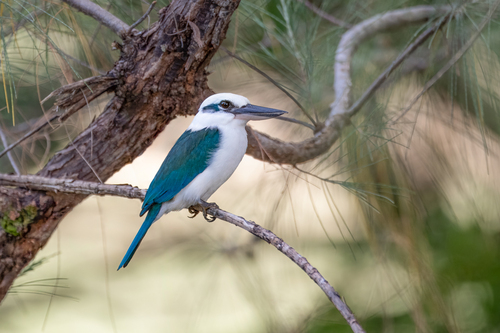
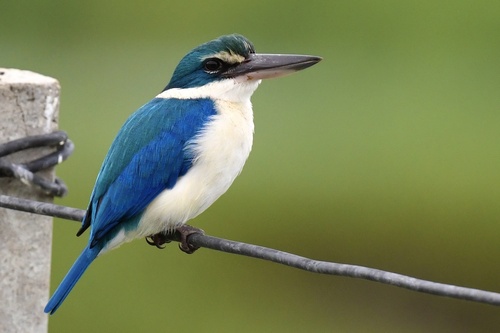
The collared kingfisher, scientifically named Todiramphus chloris (Boddaert, 1783), measures 23 to 25 cm (9.1 to 9.8 in) in length. Males weigh 51 to 90 g (1.8 to 3.2 oz), while females weigh 54 to 100 g (1.9 to 3.5 oz). Its upper plumage ranges in color from blue to green, and its underparts can be either white or buff. It has a distinctive white collar around its neck, which gives the species its common name. Some subspecies have a white or buff stripe above the eye, while others have a white spot between the eye and bill. A black stripe may run through the eye. The bird’s large bill is black, with a pale yellow base on the lower mandible. Females generally have greener plumage than males. Immature collared kingfishers are duller in color than adults, and have dark scaly markings on the neck and breast. This species produces a variety of calls that differ across geographic regions. The most common call is a loud, harsh, metallic "kee-kee-kee" that is repeated multiple times. The collared kingfisher is most often found in coastal areas, especially in mangrove swamps. It also lives on farmland, in open woodland, grassland, and gardens. In some parts of its range, particularly on islands, it can be found further inland, extending into forests or mountain areas. These birds often perch visibly on wires, rocks, or bare branches. The subspecies with the westernmost range on the Eurasian/African landmass is T. c. abyssinica, which is found in northeast Africa. It occurs in mangrove patches in Eritrea, and has also been recorded in Sudan and Somalia. Further east in Arabia, the subspecies T. c. kalbaensis is endangered, with a total population of 55 pairs or fewer. This subspecies is almost entirely restricted to Khor Kalba in the United Arab Emirates, but breeding has recently been recorded at Khor Shinas in Oman. Additional subspecies occur locally along the coasts of India and Bangladesh, and on the Andaman and Nicobar Islands. In Southeast Asia, Indonesia, and the Philippines, the species is widespread and common, and can be found far inland in some regions. For breeding, the collared kingfisher builds its nest in a hole. This hole may be a natural tree hollow, or a burrow that the birds dig themselves into a rotten tree, an arboreal termite nest, or an earth bank. They will also use old woodpecker holes. The clutch usually contains two to five rounded, whitish eggs, which are laid directly on the floor of the hole; no nesting material is used. Both parents incubate the eggs and feed the chicks. Young birds leave the nest approximately 44 days after hatching. It is common for collared kingfishers to raise two broods in a single year.