About Tockus leucomelas (M.H.K.Lichtenstein, 1842)
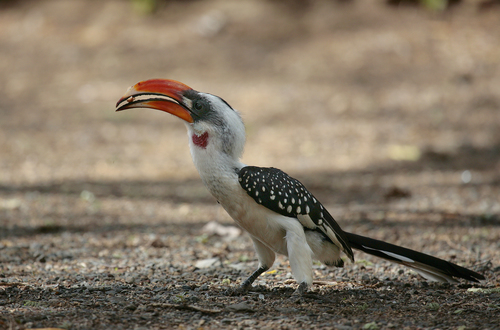
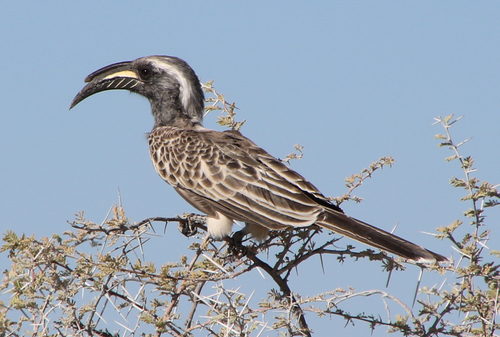
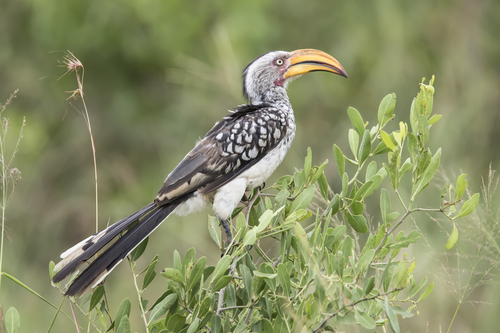
The southern yellow-billed hornbill (scientific name: Tockus leucomelas, first described by M.H.K. Lichtenstein in 1842) is a medium-sized hornbill, measuring 48–60 cm (19–24 in) in total length and weighing 132–242 g (0.29–0.53 lb). It is defined by its long, yellow, down-curved beak, which is large relative to its body and can make up to one-sixth of the bird’s full body length. On average, male beaks measure 90 mm long, while female beaks average 74 mm. Males are generally larger than females, though there is overlap in body size between the sexes; beak size difference is a fairly reliable way to tell males and females apart in wild populations. Like all hornbills, this species has a casque on the upper beak, which is very small in the southern yellow-billed hornbill. In males, the small casque extends almost the full length of the beak, and it covers even less length in females — this can give the false impression that the species does not have a casque at all. As with all hornbills, the large size of the beak blocks part of the bird’s frontal vision, and the first two neck vertebrae are fused together. Like most other hornbills, southern yellow-billed hornbills have a long tail, long eyelashes, and short, stubby legs and toes. The three front toes are fused together near their base. Their plumage includes a white belly, grey neck, and black back feathers with numerous white spots and stripes. The grey neck has grey spots, and the chest has faint black striping. Southern yellow-billed hornbills have no plumage pigmentation other than melanin, which only produces black and white coloration. Their eyes are usually yellow, though brown eyes have also been observed. The skin around the eyes and along the malar stripe is pinkish; by comparison, the closely related eastern yellow-billed hornbill from north-eastern Africa has blackish skin around the eyes. This species is nearly endemic to the dry savannas of southern Africa, where it occurs across all longitudes of the region, ranging from Angola and Namibia in the west to Mozambique and KwaZulu-Natal in the east. Its range also includes Botswana, Zimbabwe, and northern South Africa. Southern yellow-billed hornbills live mostly in dry, open savannas, but they also strongly favor woodlands when available. In woodlands, they prefer acacia woodlands and broadleaved woodlands. The highest recorded concentration of the species is found in open mopane scrub. Breeding season for southern yellow-billed hornbills begins with the first autumn rains, and runs overall from September to March, with the peak egg-laying period falling between October and December. Eggs are laid during the wet season, so peak laying timing varies by region to match local rainy season patterns. For example, the peak typically runs from November to February in the eastern regions of the species’ range, and from December to March in the northwest regions. These peaks align with each region’s annual peak rainfall. Young southern yellow-billed hornbills reach sexual maturity at one year old. Before breeding occurs, the pair completes courtship behaviors including courtship feeding of the female, mutual preening, copulation, and prospecting for nest sites. After mating, the male remains with his mate, and the pair establishes and defends a territory. Nests are built in natural cavities in trees, cliffs, or earthen banks, located 1 to 12 meters above the ground. The male brings bark, leaves, and grass to line the base of the nest cavity. During nest preparation, the female seals herself inside the cavity, building a wall to block the entrance from her own droppings and leftover food; the male assists by bringing mud for her to use in the wall. Only a narrow vertical slit, running from the top to the bottom of the entrance, is left open. The male passes food through this slit to the female and chicks using his beak, and the female and chicks forcibly expel their waste out through the same opening. The vertical slit creates good air circulation via convection, and when paired with the cavity’s wooden walls, it provides effective insulation. Nests usually hold 2 to 6 eggs, which take approximately 24 days to hatch. The eggs are white and oval-shaped, with finely pitted shells. Chicks hatch naked, with pink skin. The male feeds both the female and the chicks, bringing food back to the nest and dropping it through the entrance slit. Most nests also have a long escape tunnel, for use if a predator enters the cavity to attack. While confined inside the sealed nest, the female sheds all her flight and tail feathers at once, and regrows them while she remains with the chicks. Once the chicks are half-grown, the female breaks out of the sealed nest to help the male provision food. The chicks then rebuild the entrance wall themselves, and continue to be fed through the slit by both parents. When the chicks are fully grown, they break out of the nest and begin flying.