About Tityra semifasciata (Spix, 1825)
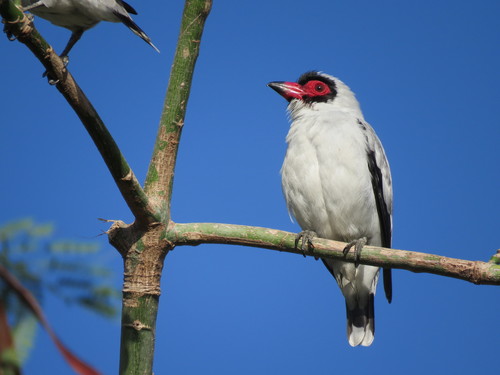
The masked tityra (Tityra semifasciata) is 20 to 24 cm (7.9 to 9.4 in) long and weighs 77 to 88 g (2.7 to 3.1 oz). The species shows sexual dimorphism. For the nominate subspecies T. s. semifasciata, adult males have bare rosy red skin that extends from their bill to and around their eye. They have a black forecrown, and this black color wraps behind and under the red skin. The rest of their head and their upperparts are pale grayish white with a strong pearly gray cast. Their wings are mostly black with grayish white tertials. Their tail is grayish white with a wide black band near the tip. Their throat and underparts are whitish. Adult females have the same bare red skin as males, but have no black on the head. Their head is a smokier gray than the male's, and their upperparts are a darker gray than the male's with brown streaks and smudges. Their wings and tail match the male's pattern, and their throat and underparts are a dingy pale gray. Other subspecies of the masked tityra differ from the nominate subspecies and from each other as follows: T. s. hannumi is very similar to the nominate. For T. s. griseiceps, males have grayer upperparts, while females have a pale gray head and upperparts, a gray-brown wash on the back, and paler, grayer wing coverts. T. s. deses is paler overall. For T. s. personata, males have grayish brown head and upperparts, darker on the head. For T. s. costaricensis, males have paler gray upperparts, wing coverts, and tail base, while females are darker than nominate individuals, especially on the head. For T. s. columbiana, males have less white on the base of outer tail feathers, while females have browner upperparts. For T. s. nigriceps, males are whiter overall, with more black on the face and a wider black tail band. T. s. fortis is very similar to the nominate, but has a longer bill. Both sexes of all subspecies have a reddish brown to brick-red iris, a slightly hooked rosy red bill with a black tip, and blackish legs and feet.
Each subspecies of the masked tityra has a distinct distribution: T. s. hannumi is found in northwestern Mexico, in southeastern Sonora, southwestern Chihuahua, and northeastern Sinaloa. T. s. griseiceps occurs in coastal western Mexico, from north-central Sinaloa south to southern Oaxaca. T. s. deses lives in Yucatán and northern Quintana Roo, in southeastern Mexico. T. s. personata ranges from eastern Mexico (southwestern Tamaulipas to Campeche) south through Belize, both sides of Guatemala, central and western Honduras, and El Salvador, into north-central Nicaragua. T. s. costaricensis is found from southeastern Honduras south through most of Nicaragua and Costa Rica into western and central Panama, including Coiba and Cébaco islands. T. s. columbiana occurs in eastern Panama, western Colombia (extending to Chocó Department and east across the country), the Serranía del Perijá on the Colombia-Venezuela border, both slopes of the Venezuelan Andes, and the Venezuelan Coastal Range from Yaracuy to Miranda. T. s. nigriceps ranges from Nariño Department in extreme southwestern Colombia south through western Ecuador to Guayas and northwestern Azuay provinces. T. s. semifasciata (the nominate) is found in Brazil south of the Amazon River, from central Amazonas state to the Atlantic coast in Amapá, and south to Rondônia, southern Mato Grosso, and northern Goiás, extending into eastern Paraguay; it possibly ranges as far south as far northeastern Argentina. T. s. fortis occurs on the east slope of Colombia's Eastern Andes, and south through eastern Ecuador, eastern Peru, into northern and eastern Bolivia, and east into Brazil's Amazonas state. Some sources list Trinidad and French Guiana as part of the species' range, but the South American Classification Committee has no records of the species from either country.
The masked tityra lives in a variety of somewhat open forested landscapes in the tropical and lower subtropical zones. These include the canopy, clearings, and edges of lowland evergreen forest, montane evergreen forest, and secondary forest, plus semi-open woodland, savanna with scattered trees, and plantations. In terms of elevation, its range extends from sea level to 2,500 m (8,200 ft) in western Mexico and northern Central America, to 1,800 m (5,900 ft) in Costa Rica and Venezuela, to 1,600 m (5,200 ft) in Colombia and Peru, and to 1,100 m (3,600 ft) in Ecuador.