About Tityra inquisitor (Lichtenstein, 1823)
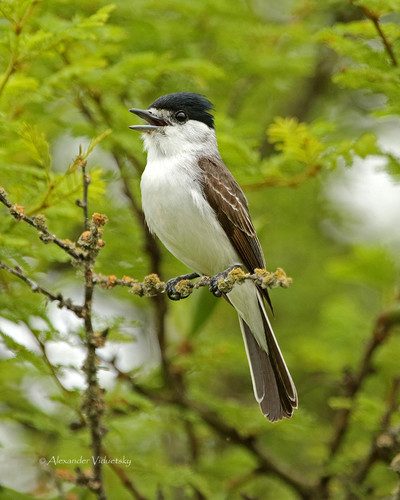
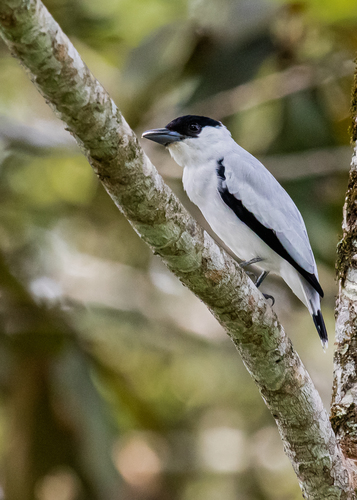
Black-capped tityra (Tityra inquisitor (Lichtenstein, 1823)) measures 16.5 to 20.5 cm (6.5 to 8.1 in) in length and weighs 33.8 to 70 g (1.2 to 2.5 oz). The species is sexually dimorphic. Adult males of the nominate subspecies T. i. inquisitor have a mostly black head, with whitish gray nape and upperparts that carry a pearly gray cast. Their wings are mostly black with grayish white tertials, their tail is black, and their throat and underparts are white. Adult females have a buffy forehead and a black cap set on an otherwise chestnut or rusty face. Their upperparts are a slightly darker gray than males, with dusky brownish streaks and coarse blackish spots. Their wings and tail match the male's pattern, and their throat and underparts are washed with a dingy pale grayish buff. Six total subspecies differ from the nominate and each other in the following ways. For T. i. fraserii: males have a white nape and cheeks, darker back, white inner webs of primaries, and pale grayish white underparts; females have a more brownish, less grayish back. For T. i. albitorques: males have white cheeks and ear coverts, a pale gray back, a mostly white tail with a black band near the end, and grayish underparts; females have an unspotted variably brownish-washed back, plus a white lower belly and white undertail coverts. For T. i. buckleyi: males have white cheeks and ear coverts, and a mostly black tail with white at its base. For T. i. erythrogenys: males have less white on the nape and very little white at the base of the tail; females have a gray back with no brown but variable black spots, and a white throat and breast with a slight grayish tinge. For T. i. pelzelni: the tail is mostly white. Both sexes of all subspecies have a dark iris, a bluish gray upper mandible (maxilla), a blackish lower mandible (mandible), and blackish legs and feet. Each subspecies has a distinct distribution range. T. i. fraserii ranges from southeastern San Luis Potosí, Veracruz, eastern Puebla, northern Oaxaca, Tabasco, Chiapas, and the Yucatan Peninsula in Mexico, south through northern Guatemala, Belize, southeastern Guatemala, eastern Honduras, eastern Nicaragua, both sides of Costa Rica, to central Panama including islands off Chiriquí Province. T. i. albitorques occurs in eastern Panama, and from northern Colombia south through the Magdalena River valley and along western Colombia into western Ecuador as far as Azuay Province; it is also found in eastern Peru, northwestern Bolivia, and northwestern Brazil east along the Amazon to Manaus. T. i. buckleyi ranges from southern Colombia south through eastern Ecuador to Pastaza Province, and may occur in far northeastern Peru. T. i. erythrogenys is found in Colombia east of the Andes, extending east into Venezuela, across the Guianas, and into northern Brazil north of the Amazon; within Venezuela it occurs west of the Andes, east of the Andes, across the country's northern half, and south through western Bolívar and western Amazonas states. T. i. pelzelni occurs in northern and eastern Bolivia, extending east into Brazil south of the Amazon River, where its range is roughly bounded by the Madeira River, eastern Maranhão, and Mato Grosso. The nominate subspecies T. i. inquisitor is found in eastern and southeastern Brazil, from southern Piauí south through western Bahia and beyond to northern Rio Grande do Sul, and also occurs in eastern Paraguay, and northeastern Argentina as far as Corrientes Province, including eastern Formosa and Chaco provinces. The black-capped tityra inhabits lowland evergreen forest and secondary forest in tropical and lower subtropical zones. It favors the forest canopy and edges, clearings, and areas along waterways. It can also be found in plantations and várzea forest. Overall, it occurs from sea level up to about 1,200 m (3,900 ft) in elevation; it reaches only 700 m (2,300 ft) in Ecuador, 600 m (2,000 ft) in Peru, and 1,100 m (3,600 ft) in Venezuela.