About Titanostrombus galeatus (Swainson, 1823)
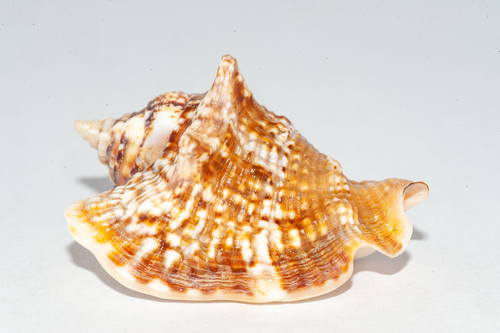
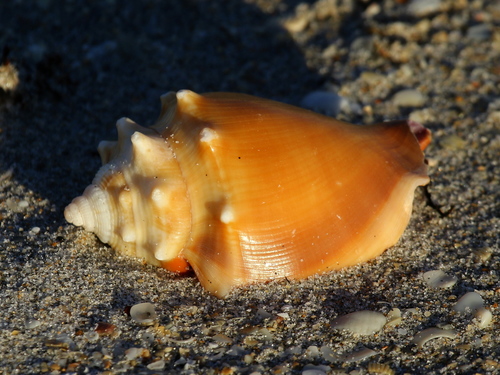
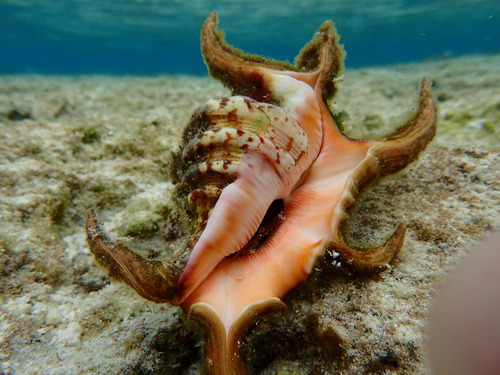
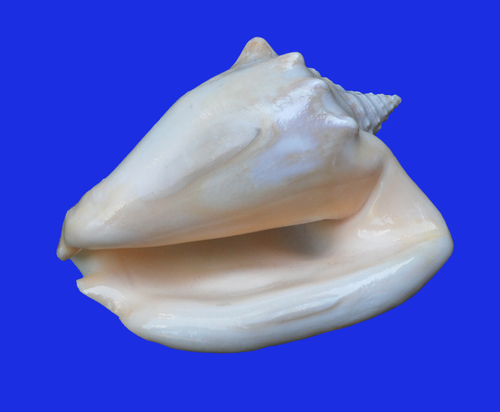
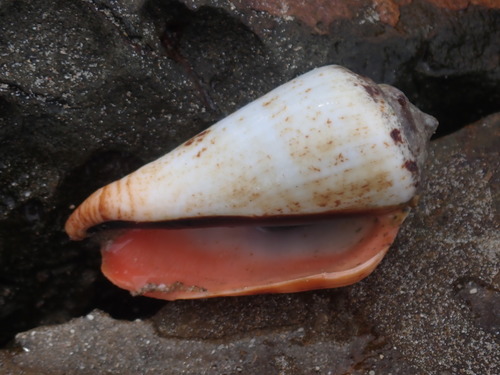
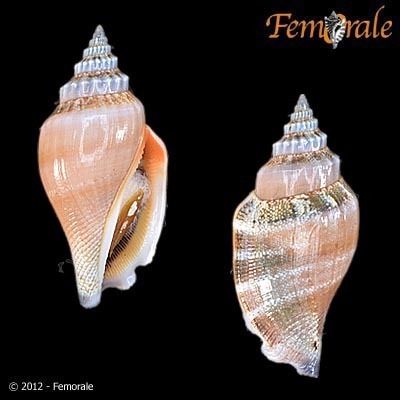
The shell of Titanostrombus galeatus is large, with a maximum recorded size of 23 cm (8.97 inches) and a common adult size of up to 14 cm (5.46 inches). The shell is very thick and heavy, with an oblong overall outline. It has a short, pointed spire that has no spines or nodules, and the spire is often eroded. The body whorl is very inflated, marked by numerous spiral ridges and low, slightly noticeable nodules along its shoulder. The periostracum is thick. The outer lip is very flared and expanded toward the posterior, and does not extend higher than the apex of the spire. The edge of the outer lip has a shallow stromboid notch, which is often associated with undulations that come from the superficial spiral sculpture of the shell. The columella is smooth, and this species has a well-developed callus on the columella. Externally, the shell ranges in color from ivory white to light brown, with a darker spire and a brown periostracum. The aperture is bright white; in older specimens, the outer lip and columellar callus are often extensively orange or dull brown.
Titanostrombus galeatus is found in coastal waters of the eastern Pacific Ocean across multiple countries and regions: the Gulf of California (Mexico), Pacific Panama, Nicaragua, Costa Rica, Ecuador, the Galapagos Islands, and Peru. This species lives on rocky and sandy bottoms near mangrove areas. It occurs at depths from the low tide mark down to 15 meters, with rare records reaching as deep as 30 meters.
In the early months of the year, this species shows gregarious behavior, forming large agglomerations in shallow waters. This aggregation lines up with its mating season, which is also when oviposition takes place. Females typically lay eggs in clusters called egg masses, which are deposited either directly on sand or on dead mollusk shells.
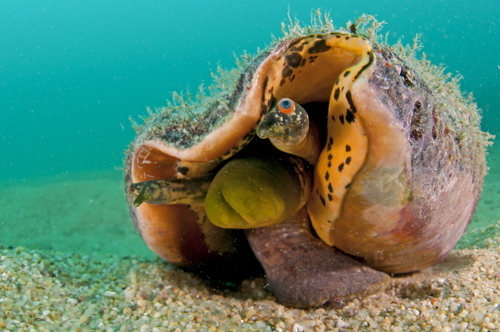
During the 19th century, strombid gastropods were incorrectly thought to be carnivores. This mistake came from the work of French naturalist Jean Baptiste Lamarck, whose classification grouped strombids with carnivorous sea snails. Later studies completely refuted this idea, and confirmed that strombid gastropods are herbivorous. Titanostrombus galeatus feeds primarily on macroalgae, and occasionally on detritus. Predators of this giant conch include invertebrates such as octopuses, and vertebrates including rays (cartilaginous fish in the family Myliobatidae), triggerfish (family Balistidae), and snappers (perciform fish in the family Lutjanidae).
Giant conch shells were used as wind instruments by the Chavín, a pre-Incan civilization that lived in the northern Andean highlands of Peru. To prepare the shells for musical use, a mouthpiece was made by cutting off the small tip of the spire and polishing the resulting hole, creating a trumpet-like instrument. In 2001, twenty of these instruments were excavated from the Chavín de Huantar archaeological site; they are nearly three thousand years old. This type of playable conch shell is still used in the Andes, where it is known as a pututu. Titanostrombus galeatus is edible, and is an economically important species across much of its range. It is targeted for both subsistence use and commercial fishing.