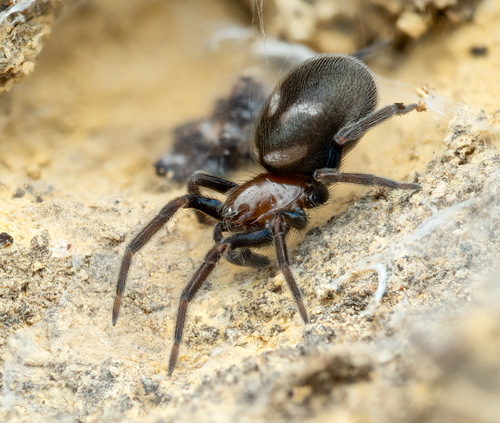
About Titanoeca quadriguttata (Hahn, 1833)
Titanoeca quadriguttata is a spider species that belongs to the family Titanoecidae. It has a widespread distribution across Europe, but it is not found in Great Britain. Confirmed localities for the species include Austria, Belgium, Bulgaria, Corsica, Croatia, Czech Republic, France, Germany, Greece, Hungary, Italy, Liechtenstein, Moldova, Russia, Slovakia, Spain, Switzerland, the Netherlands, and Ukraine. Females of this species reach roughly 6 mm in body length, with a plain dark brown abdomen and a dark cephalothorax. Males reach approximately 4.5 mm in body length; they have a broad, light reddish-brown cephalothorax, a slimmer black abdomen marked with two pairs of shining white dots. While T. quadriguttata has a similar general appearance to Titanoeca psammophila, it is larger than that species. The epigyne in females and male palpal organs are distinct from T. psammophila, and the shape of the palpal tibia when viewed from above is also different. Additionally, male T. quadriguttata lack the abdominal spots that male T. psammophila have. Like all other members of its genus, this spider has a calamistrum on the metatarsus of its fourth pair of legs. This structure consists of a single row of bristles that extends along most of the metatarsus length. These spiders reach maturity in spring; adult individuals can be found from May to July in limestone regions of Germany. They are commonly found in leaf litter, or under logs and stones, where they construct retreats. An open-meshed cribellate web extends outwards from the opening of the retreat. Before mating, males tug on the threads of the female's web. After producing eggs, the female stays with her egg sac inside the retreat. Male T. quadriguttata have a superficial resemblance to males of Callilepis schuszteri, a species in the family Gnaphosidae. However, C. schuszteri has protruding spinnerets and a silvery carapax, unlike T. quadriguttata.

