About Tipula oleracea Linnaeus, 1758
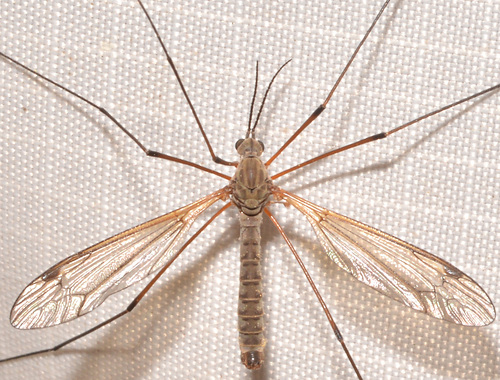
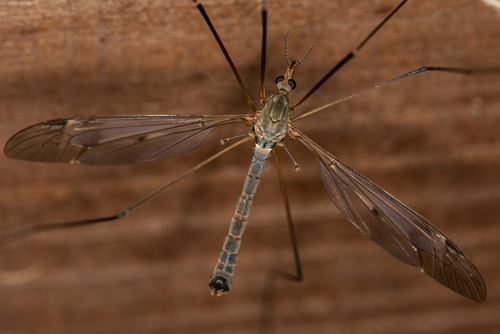
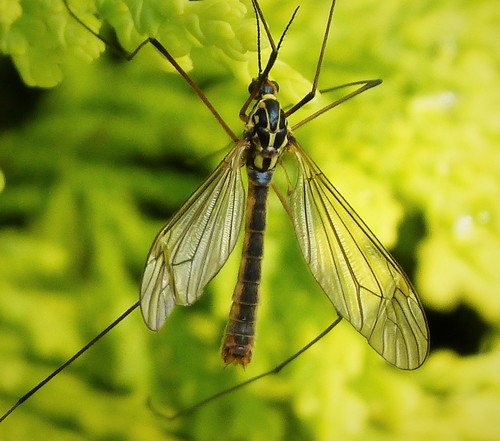
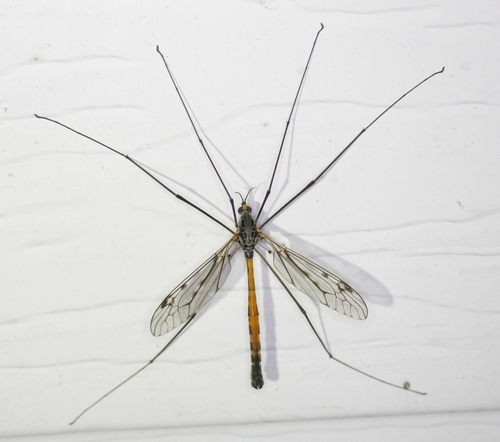
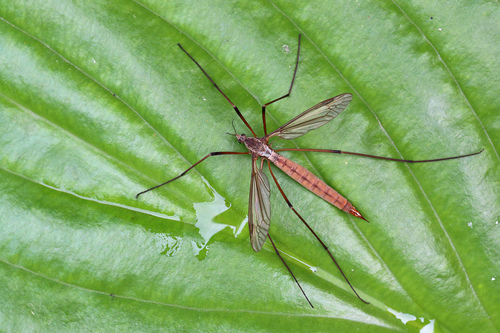
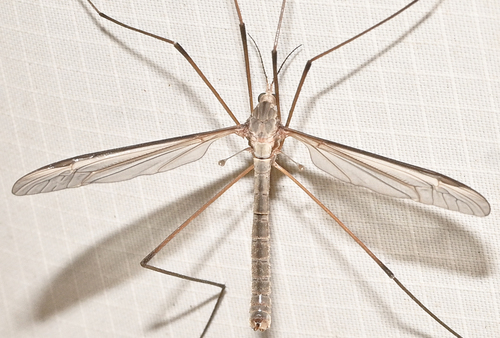
Tipula oleracea Linnaeus, 1758 is usually a greyish species, though its abdomen may occasionally be ferruginous, and often has a blackish median and/or lateral longitudinal stripe. Its wing length ranges from 18 to 28 mm. The minimum space between the eyes below is at most equal in size to the maximum width of the antenna scape, and the antennae have 13 segments. In males, the 9th tergite has a short median projection that is broader at its base than it is long, and is roundly bifurcated at the apex, with the bifurcations being blackish; the 8th sternite is simple, and the 9th sternite is almost fused with the 9th tergite, a feature also seen in T. paludosa and T. czizeki. In females, the wings are the same length as the abdomen; the sternal valves usually extend to roughly two-thirds of the length of the cerci, and the cerci are only slightly clubbed at their tips. T. oleracea is primarily prevalent in Europe. Its habitat extends south into North Africa, with an eastern limit at Algeria. In Europe, its southeastern boundary lies in Greece. It occurs as a subspecies on some Greek islands including Crete, and is also found on Malta. It is present in most of Northern Europe, with the exception of Finland and Latvia. It was probably introduced as an invasive species to North and South America; in western North America it is found from British Columbia to California, and in eastern North America it occurs between Michigan and New York. It has been introduced to Ecuador in South America.