About Tingena clarkei Philpott, 1928
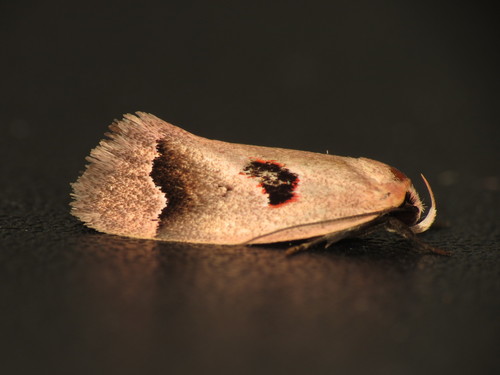
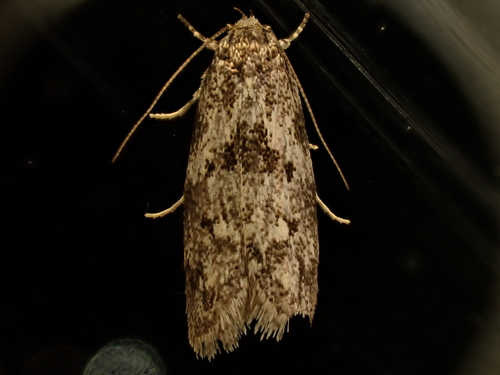
Alfred Philpott originally described the male of Tingena clarkei as follows: Male. 15–16 mm. Head and antennae are greyish-fuscous, with male antennal ciliations reaching ¾ the length of the antenna. Palpi are fuscous, with the second segment mixed with white on the inner side. Abdomen is fuscous-grey. For legs: the anterior pair are fuscous, the middle pair are fuscous with tibiae and tarsi banded with whitish, and the posterior pair are fuscous-grey. Forewings are moderate in size, the costa is noticeably arched, the apex is rounded, the termen is rounded and oblique; the wing is white, speckled with dark fuscous scales; stigmata are blackish; the plical stigma is large, located obliquely before the first discal stigma, and merges with a dark patch on the dorsum; the speckled dark scaling forms blotches on the costa at the base, ⅓, ½, and ⅔ from the base; an apical blotch extends a faint line to the tornus, where it forms a tornal blotch: fringes are whitish-grey mixed with fuscous. Hindwings and their fringes are fuscous-grey.
This species can be misidentified as Trachypepla photinella. Tingena clarkei is endemic to New Zealand. Aside from its type locality of Kauri Gully, it has been collected near Mangamuka in Northland, and in Albany, north of Auckland. It has also been observed in Otago. Adults of this species are in flight from November to February, and live in open scrubland or native forest.