About Tingena chloradelpha (Meyrick, 1905)
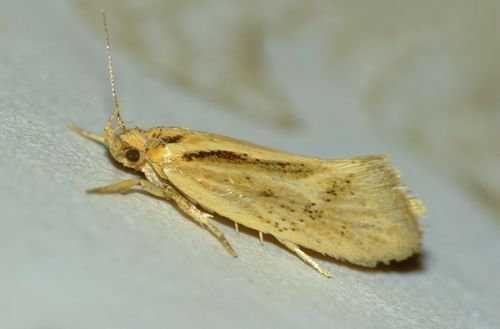
The scientific name of this species is Tingena chloradelpha (Meyrick, 1905). Hudson described the larva of this species as follows: The larva, discovered by Mr. R. M. Sunley, is approximately 3⁄4 inch in length. Its head is very small, blackish-brown, and horny; the second segment is also entirely horny and strongly constricted behind it. The third segment has two large horny plates, while the fourth segment has four very small horny plates. The rest of the body is very stout, soft, and dull blackish-brown, with a darker dorsal line. Each segment has at least four distinct oblong pale patches, and each patch has a minute horny wart at its centre. The pupa of this species is enclosed in a weak, pale white silken cocoon. Meyrick described the adult moths of this species as follows: Male and female individuals have a wingspan of 18 to 20 mm. The head is whitish-ochreous. The palpi are ochreous-whitish, and the basal half of the second joint is sometimes speckled with dark fuscous. The antennae are whitish and ringed with dark fuscous; male antennae have cilia of length 1. The thorax is whitish-ochreous, with brown subdorsal stripes. The abdomen is ochreous-whitish. The fore-wings are elongate, with a moderately arched costa, pointed apex, and faintly sinuate, rather strongly oblique termen; the fore-wings are pale whitish-ochreous, and along the dorsum and on the posterior half are more or less partially tinged with brown and sprinkled with brown and dark brown; a suffused brown streak mixed with dark brown runs along the submedian fold from the base to the tornus; the stigmata are fuscous and often indistinct, with the plical stigma positioned obliquely beyond the first discal stigma; a subterminal line of dark fuscous scales is only very vaguely indicated. The cilia are pale whitish-ochreous, more or less sprinkled with fuscous. The hind-wings and their cilia are ochreous-whitish. This species is similar in appearance to T. griseata and T. innotella, but can be distinguished from these two species by its general whitish-ochreous colouring, the brown submedian line on its forewings, and its whitish shaded hindwings. This species is variable both in the depth of its overall colour and in the colour intensity of its discal dots, which may be absent entirely in some specimens. This species is endemic to New Zealand. In addition to its type locality of Wellington, this species has also been observed on Kapiti Island, and in New Plymouth, Christchurch, and Otago. The larvae of this species live underground, form silken tunnels, and feed on grass roots. They are commonly found in domestic gardens and on cultivated land. The larvae of this species overwinter, remaining underground within the silken tubes they inhabit and feed from. Adult moths of this species are active from October through the end of December. Adults are often observed resting on window frames, and are frequently found inside houses.