About Tineola bisselliella (Hummel, 1823)
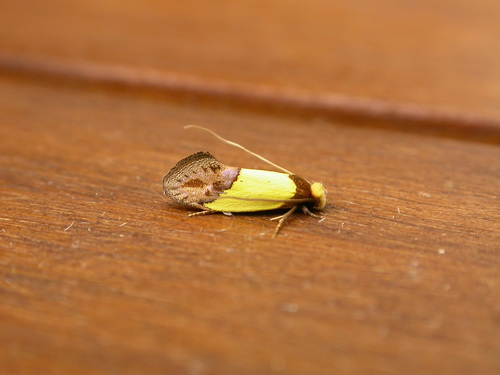
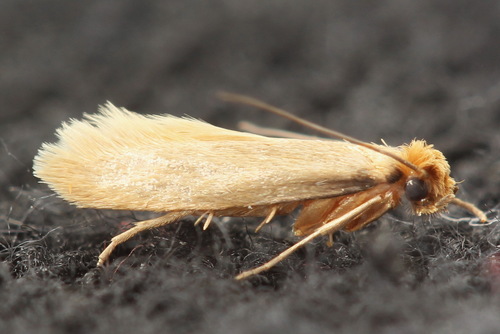
Tineola bisselliella (common clothes moth) is a small moth species with a body length of 6–7 mm (0.24–0.28 in) and a wingspan of 9–16 mm (0.35–0.63 in), most commonly 12–14 mm (0.47–0.55 in). Its head is light ferruginous ochreous, sometimes with a brownish tinge, and it has a characteristic red-orange tuft of hair on the head. The antennae are thread-like and reach about four-fifths the length of the forewings. Forewings are pale yellowish-ochreous, with a fuscous base to the costa. Hindwings are ochreous grey-whitish. This yellow-brown or ochreous overall coloring, paired with the head's red-orange hair tuft, distinguishes Tineola bisselliella from similar species.
The larva is white, becoming almost transparent as it develops, and has a brown head. It lives inside a self-constructed silk tube.
The species' natural native range is the western Palearctic, but it has been spread to other regions by human travel; it is now established in Australia, for example. It has not been formally recorded in France, Greece, Slovenia and Switzerland, but this is most likely due to a lack of collected occurrence data rather than true absence from these areas.
Tineola bisselliella is widely known for feeding on clothing and natural fibers, as its larvae can digest the keratin protein found in wool and silk. Adult moths do not feed at all — their mouthparts are atrophied, so all fabric damage is caused by larval feeding. Females prefer to lay eggs on soiled fabric, and are particularly attracted to carpeting and clothing that hold human sweat or other spilled organic liquids; dirt traces provide essential nutrients for larval development. Larvae are drawn to these areas for both food and moisture traces, and do not need to drink liquid water.
Recorded food sources for the larvae include linen, silk, wool fabrics, and furs. They will eat synthetic and cotton fibers if these are blended with wool, and may use some cotton to build their cocoons. Larvae have also been found feeding on shed feathers and hair, bran, semolina, flour (most likely preferring wheat flour), biscuits, casein, and preserved insect specimens in museum collections. In one documented case, living T. bisselliella caterpillars were found in salt. They had likely wandered there by accident: pure sodium chloride has no nutritional value for this species, and acts as a strong desiccant, but the find still demonstrates the larvae's high robustness.
Unfavorable temperature and humidity levels slow larval development, but do not always stop it entirely. Both adult and larval Tineola bisselliella prefer low light conditions. Unlike many other Tineidae moths, common clothes moths favor dim or dark environments. If larvae end up in a brightly lit room, they will move to hide under furniture or along carpet edges. Larvae favor handmade rugs, as it is easy for them to crawl underneath and cause damage from below. They also move under room edge moldings to seek dark areas that accumulate fibrous debris and thus good food sources. Larvae may occasionally act as bookworms, chewing through paper (which gives them no nutrition) to reach book bindings or mold colonies for nourishment.
Female Tineola bisselliella lay eggs in clusters of 30 to 200. The eggs adhere to surfaces with a gelatin-like glue, and hatch between 4 and 10 days into near-microscopic white caterpillars that begin feeding immediately. Larvae spin protective silk mats to feed out of sight, and partially emerge from these mats only at night or in dark conditions to forage for food. Larval development goes through between 5 and 45 instars, and typically takes between one month and two years before the pupal stage begins. Once ready to pupate, caterpillars spin cocoons and spend an additional 10 to 50 days developing into adult moths.
After emergence from pupation, adult moths begin searching for mates. Females generally move less than males, and both sexes prefer scuttling across surfaces over flying — some adults never fly at all. Adults live for an additional 15 to 30 days before dying; if mating and egg laying occur earlier, males die shortly after mating and females die shortly after finishing egg laying. Under the most favorable conditions (24 °C / 75 °F and 70–75% relative humidity), the full life cycle can be completed in as little as one month. In cooler, drier conditions, development proceeds very slowly and the life cycle can take multiple years. Larvae will still hatch and grow at temperatures as low as 10 °C (50 °F), and can survive temperatures up to 33 °C (91 °F).
Adult moths do not feed, as they gain all required nutrition and moisture during the larval stage, and only seek to reproduce once they leave their cocoons. In the wild, the species is seasonal, but heated indoor environments allow Tineola bisselliella to develop year-round. The full life cycle from egg to the next generation's eggs typically takes 4–6 months, with two generations produced per year.