About Tinamus major (J.F.Gmelin, 1789)
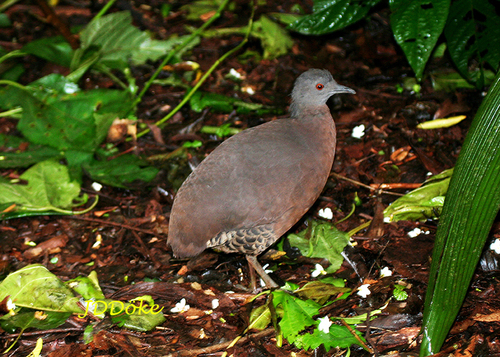
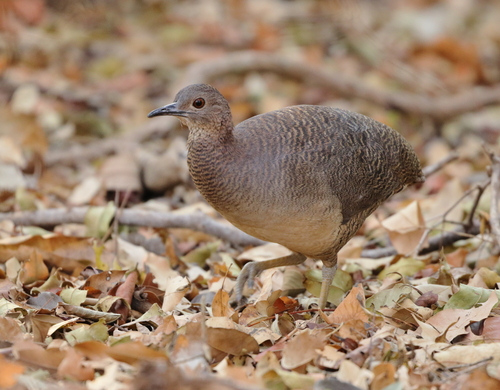
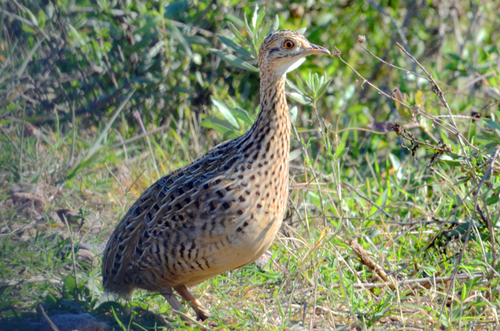
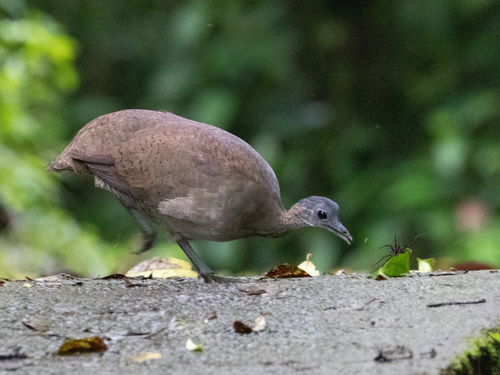
The great tinamou, with the scientific name Tinamus major (J.F.Gmelin, 1789), is a large species of tinamou. Its total body length measures approximately 38 to 46 cm (15 to 18 in), with an average length of 44 cm (17 in). Male great tinamous weigh between 700 and 1,142 g (1.543 to 2.518 lb), with an average weight of 960 g (2.12 lb), while females weigh between 945 and 1,249 g (2.083 to 2.754 lb), with an average weight of 1,097 g (2.418 lb). Despite its common name, large size and shape, which may resemble a large pheasant or a small turkey, it is not automatically the largest tinamou species: other species in the genus Tinamus match or surpass its size. Its base body color ranges from light to dark olive-green, with a whitish throat and belly, black barring on the flanks, and cinnamon-colored undertail. Its crown and neck are rufous, and its occipital crest and supercilium are blackish. Its legs are blue-grey. All of these markings allow the great tinamou to blend in effectively when on the rainforest understory. This species has a unique, distinctive call: three short, tremulous but powerful piping notes, that can be heard in its rainforest habitat during early evenings. Among all bird species, the great tinamou has the highest percentage of skeletal muscle dedicated to locomotion, making up 56.9% of its total body weight; 43.74% of its total body weight is skeletal muscle dedicated to flight. By contrast, its heart is the smallest of all bird species when measured as a proportion of body weight, at just 0.19%. The great tinamou inhabits subtropical and tropical forests, including rainforest, lowland evergreen forest, river-edge forest, swamp forest, and cloud forest, at altitudes between 300 and 1,500 m (1,000–4,900 ft). Unlike some other tinamou species, the great tinamou is not heavily impacted by forest fragmentation. Its nest is located at the base of trees.