About Timon lepidus (Daudin, 1802)
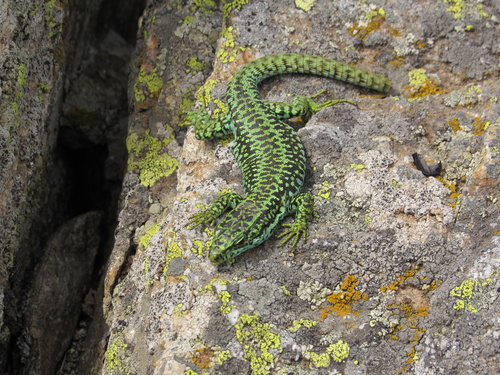
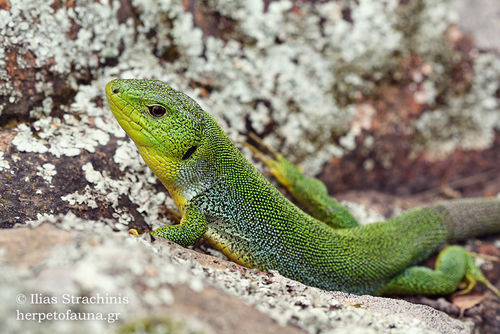
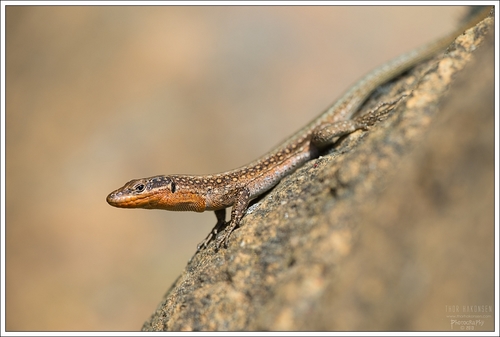
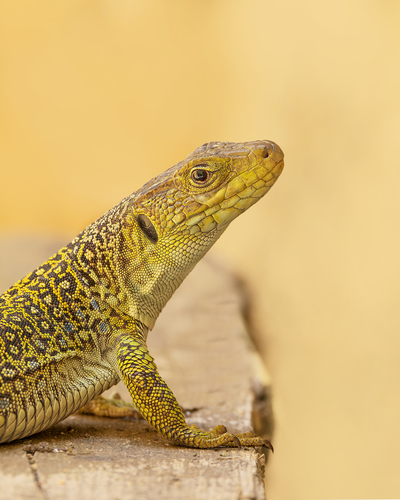
Timon lepidus is one of the largest species in its family. Adult individuals measure 30 to 60 cm (0.98 to 1.97 ft) in total length including the tail, and can reach a maximum total length of 90 cm (3.0 ft), with a body weight over 0.5 kg (1.1 lb). Roughly two-thirds of the lizard's total length is made up by its tail. Newly hatched juveniles measure 4 to 5 cm (1.5 to 2 in) in length when measured without the tail. This species is a robust lizard with a serrated collar; males have a characteristic broad head. It has thick, strong legs with long, curved claws. The dorsal background color is most often green, but may sometimes be grey or brownish, particularly on the head and tail. This base color is overlaid with black stippling that can form a bold pattern of interconnected rosettes. The underside is yellowish or greenish; both males and females have bright blue spots along their flanks, with males typically showing brighter coloration than females. Juvenile lizards are green, grey, or brown, with yellowish or white spots that often have black edges across their entire body. Timon lepidus is native to southwestern Europe. It occurs across the entire Iberian Peninsula, including Spain, Portugal, and Gibraltar, and has a patchy distribution in southern France and extreme northwestern Italy. It is also found in northwestern Tunisia, specifically in the forests of Ain Soltane and El Feija in Ghardimaou, Jendouba. The subspecies Timon lepidus ibericus is found in the northwestern Iberian Peninsula (Spain and Portugal), alongside the other recognized subspecies Timon lepidus lepidus and Timon lepidus oteroi. Timon lepidus inhabits a range of wild and cultivated habitats, from sea level up to 2,100 m (6,900 ft) in southern Spain, and is rare at higher elevations. It prefers dry, bushy areas such as open woodland, scrub, old olive groves, and vineyards, and is sometimes found in more open, rocky or sandy areas. It can occasionally be seen basking on roadsides. This lizard usually remains on the ground, but is a capable climber on rocks and in trees. It can dig its own holes, and will sometimes use abandoned rabbit burrows. Breeding for T. lepidus takes place in late spring or early summer. Males are territorial during spring and fight with one another during the breeding season. About three months after mating, females lay up to 22 eggs in June and July, hiding the eggs under stones and logs, in leaf litter, or in loose damp soil. In dry areas, females tend to lay fewer, larger eggs. The eggs hatch after 8 to 14 weeks, and individuals reach sexual maturity at two years of age.