About Timema cristinae Vickery, 1993
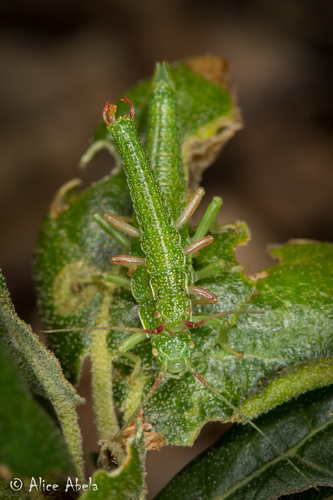
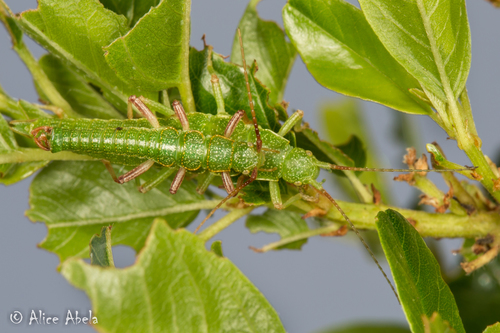
Timema cristinae Vickery, 1993 is one of the smallest stick insect species, with adult bodies reaching only 2 to 3 centimeters in length. This species has rounded bodies, an elongated abdomen, and no wings. It also shows clear sexual dimorphism: males are smaller at around 2 centimeters long and thinner than females, which reach around 3 centimeters long, and males can be identified by their red legs. Males and females also differ in the shape and size of their mandibles, with female mandibles being much longer than those of males. T. cristinae has a strong sense of smell, a trait confirmed by studies that found it has more olfactory proteins than other studied phasmid species. This species is native to the Coast Range of southern California, the United States. It is only found in a small 30-square-kilometer region of mountainous chaparral habitat, a specific type of shrubland plant community, and it is the only Timema species present in this area. T. cristinae lives within shrubs, and is most abundant on two shrub species: Adenostoma fasciculatum from the Rosaceae family, and Ceanothus spinosus from the Rhamnaceae family. These two shrub species differ greatly in appearance, especially in their leaves. A. fasciculatum has small needle-like leaves that grow in crowded bundles along branches, while C. spinosus has wide oval-shaped leaves that do not grow in dense clusters. These leaf differences are likely responsible for the existence of different T. cristinae morphs: the 'green' morph and the 'striped' morph, which is also green but has a white stripe running down its back. Research has shown the green morph has the best camouflage on C. spinosus leaves, while the striped morph is best camouflaged on A. fasciculatum leaves. A third melanistic morph is camouflaged to match the stems of both host shrubs, but is very easy to spot when on the leaves of either shrub. Female T. cristinae can reproduce throughout their entire lives, but only lay one egg at a time. When laying eggs, females ingest soil that they use to fully coat each egg as it is laid. Eggs without access to soil never hatch, and while most eggs are simply dropped from the host shrub, occasionally individuals use their abdomens to insert eggs directly into soil. Most eggs are laid in April and May, then enter a dormant developmental delay called diapause that lasts approximately 8 months, until hatching starts in December. Eggs do not all hatch at once; hatching is spread out across December and January. Occasionally, some eggs remain dormant for an extra year and do not hatch until the following December to January. Mating begins when a male climbs on top of the female's abdomen. He then performs courtship behaviors including leg and antenna waving before attempting copulation. After finishing courtship, the male stays motionless on the female's back. Mating lasts several hours, after which the male continues riding on the female's back for hours or even days to prevent her from mating with other males. Despite this behavior, T. cristinae females practice polyandry, meaning they mate with multiple males. T. cristinae populations have been shown to survive wildfires, which may be possible because of the unique soil coating female T. cristinae apply to their eggs. Because of its distinct host-associated morphs, T. cristinae is used as an eco-evolutionary model to study ongoing evolution. Most research on this species focuses on the green and striped morphs, which provide camouflage adapted to C. spinosus and A. fasciculatum respectively. Predators like birds can more easily spot individuals of a morph when they are on the wrong host plant, the one they are not ideally camouflaged for, so these mismatched individuals are less likely to survive. Researchers predict that these two morphs are in the early stages of a speciation event, meaning they will eventually become two separate stick insect species, each best adapted to one of the two host plant species. This system has drawn significant research interest because it lets researchers study evolution in real time, instead of reconstructing how and why a single species evolved into multiple species after the fact. This interest has even led to studies investigating the genes that determine which morph an individual will develop into, that is, what color and pattern it will have. In addition, even though T. cristinae only occurs in a small 30-square-kilometer region, there are some areas where only one of the two host plant species is present, and other areas where the two host plant species grow directly adjacent to one another. These different habitat setups allow researchers to study two different types of speciation. In areas with only one host plant species, researchers can study allopatry, where different populations are separated by a physical barrier that prevents interbreeding, which in this case occurs because areas with the other host plant are simply too far away. In areas where both host plant species grow right next to each other, researchers can study parapatry, where populations of a single species diverge into separate species even when their habitats are only partially separated. In parapatry, members of the different diverging populations can still occasionally interbreed.