About Tillandsia usneoides (L.) L.
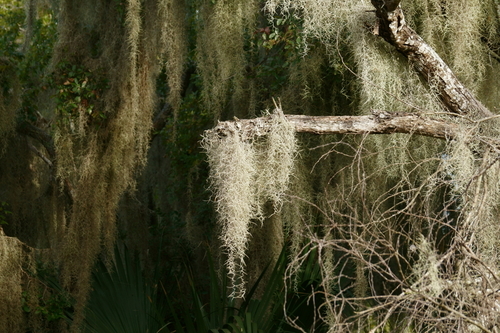
Tillandsia usneoides, commonly known as Spanish moss, is made up of one or more slender stems that bear alternate thin, curved or curly, heavily scaled leaves. These leaves measure 2–6 cm (0.8–2.4 inches) long and 1 mm (0.04 inches) broad. It grows vegetatively in a chain-like pendant fashion, forming hanging structures that can reach up to 6 m (20 feet) long; gray-green garlands have occasionally been recorded hanging as far down as 8 m (26 ft). This plant has no roots. Its flowers are small and red-pink, with spreading petals, and its scape is partly hidden within the leaf sheath. Spanish moss reproduces both sexually via seed and asexually via vegetative fragmentation; fragments are carried by wind to stick to tree limbs, or transported to new locations by birds as nesting material.
Spanish moss’s native primary range stretches from the Southeastern United States (including Puerto Rico and the U.S. Virgin Islands) south to Argentina, in regions with warm enough temperatures and relatively high average annual humidity. In North America, it grows in a broad band along the Gulf of Mexico and southern Atlantic coast. The northern limit of its natural range is Northampton County, Virginia; colonial-era records note its presence in southern Maryland, where no established populations are known to exist today. It has been introduced to many suitable locations around the world with matching climates, including Hawaii, where it first became established in the nineteenth century.
Spanish moss is not a parasitic plant; it is an epiphyte that absorbs water and nutrients through its leaves directly from air and rainfall. While it rarely kills the host trees it grows on, it can occasionally grow dense enough to shade host tree leaves, slowing the tree’s growth rate. Different tree species have different levels of tolerance to Spanish moss, and it has become an invasive problematic weed in some introduced regions. For example, in Northern Sydney, Australia, it threatens the local Sydney Turpentine Ironbark Forest, Blue Gum High Forest, and area rainforests. Spanish moss uses the water-conserving crassulacean acid metabolism pathway for photosynthesis. In the southern United States, Spanish moss shows a preference for southern live oak (Quercus virginiana) and bald cypress (Taxodium distichum), because these trees have high rates of foliar mineral leaching of calcium, magnesium, potassium, and phosphorus, which provides abundant nutrients to this epiphyte. It can also colonize other tree species including sweetgum (Liquidambar styraciflua), crepe-myrtles (Lagerstroemia spp.), other oaks, and even pines. It grows uncommonly on artificial structures like fencing and telephone lines. Spanish moss provides shelter for many animals, including rat snakes and three species of bats. One species of jumping spider, Pelegrina tillandsiae, has only ever been found living on Spanish moss. Although it is widely assumed that chiggers commonly infest Spanish moss, one ecological study that identified thousands of arthropods living on the plant found no chiggers present. This plant is sensitive to airborne contaminants, and will not grow in areas with frequent smoke, such as near chimneys. It has disappeared from many urban areas due to increasing air pollution.
Humans have used Spanish moss for a wide variety of purposes, including building insulation, mulch, packing material, mattress stuffing, and fiber. In the early 1900s, it was used commercially for padding in car seats. In 1939 alone, over 10,000 tons of processed Spanish moss was produced. Today, it is collected in smaller quantities for use in arts and crafts, as flower garden bedding, and as an ingredient in bousillage, a traditional wall covering material. In some parts of Latin America and Louisiana, it is used to decorate nativity scenes. In the desert regions of the southwestern United States, dried Spanish moss is sometimes used to make pads for evaporative coolers, commonly called "swamp coolers" or "desert coolers". These coolers cool homes and offices at a much lower cost than standard air conditioning. The technology uses a pump to spray water onto the Spanish moss pad; a fan then pulls air through the pad into the building. Evaporation of water from the pad cools the air, lowering the temperature inside the building.