About Tiliqua rugosa (Gray, 1825)
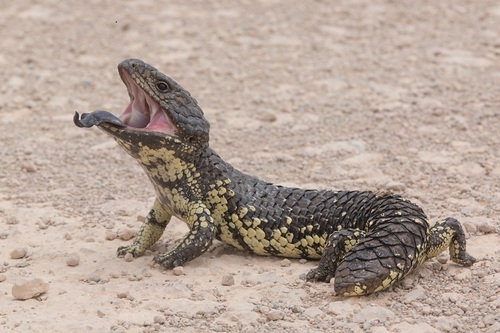
Tiliqua rugosa (first described by Gray in 1825) has a heavily armored body, and individuals show a range of colors from dark brown to cream. Its snout-vent length measures between 260 to 310 mm (10 to 12 inches), and it has a very heavy build for its length. It has small reddish-brown and grey eyes, a triangular head, a bright blue tongue inside a bright pink mouth, and a short, stumpy tail that is shaped similarly to its head. This tail similarity is thought to be a defense mechanism to confuse predators; the tail also stores fat, which has led to the common name "two-headed skink". Unlike many skinks, shingleback skinks do not have the ability of autotomy, meaning they cannot shed their tails. The average lifespan of these skinks is 10 to 15 years, though some wild individuals have been recorded to live as long as 50 years. This species normally sheds its entire skin at once, including the covering over the eyes. The shedding process takes up to several hours, and the lizard rubs against objects to help remove the old skin. Tiliqua rugosa exhibits sexual dimorphism: males are stockier than females and have larger heads, while females generally grow to a larger overall size than males. This species is widely distributed across arid to semiarid regions of southern and western Australia. Its range extends from Broome, Western Australia, across the southernmost parts of the country to the coast, and then north into Queensland. Four subspecies are found in Western Australia, including one subspecies native to Rottnest Island. It also lives in the eastern Australian states of Victoria and New South Wales, but does not occur in coastal areas of these two states. Its habitats include shrublands, eucalyptus forests, desert grasslands, and sandy dunes. Shinglebacks often shelter under low foliage in brushy areas. As cold-blooded animals, these skinks are well known for having a strong preference to sunbathe in open areas, and they are often seen along roadsides or other cleared areas within their range. On average, individual Tiliqua rugosa have a home range of four hectares, and can move up to 500 meters per day. These lizards maintain strong home range site stability for up to several years, and multiple lizards often share the same burrow. They tend to share burrows as conditions become hotter and drier. During spring, if there is adequate food that season and normal mating behavior occurs, the home ranges of males often overlap. This overlap can lead to territoriality and agonistic behavior. Tiliqua rugosa is a viviparous skink, meaning it gives birth to live young rather than laying eggs like most other lizards. Pregnancy and birth place extremely high energetic demands on females. The relative clutch mass is 26.8% ±1.5% of the mother's body mass. Brood size ranges from one to four offspring, most commonly two to three, and the offspring are relatively large. The trade-off of smaller litter size for larger individual body size increases the offspring's chances of survival. Females have a well-developed placenta that nourishes their unborn young. Unlike most other lizards, this species is typically monogamous, and pairs reunite between September and November before the breeding season each year. Pairs have been recorded returning to each other every year for up to 20 years. The breeding season runs from December to April, and the gestation period is usually 3 to 5 months. After birth, newborn skinks immediately consume their afterbirth. They stay with their parents for several months before becoming independent, but remain in close proximity to form a colony of closely related skinks. During parenting, the male of a monogamous pair eats less, remaining alert to give alarm calls. He will trail behind the female to protect her from rival males, while the female forages for food.