About Tigrisoma fasciatum (Such, 1825)
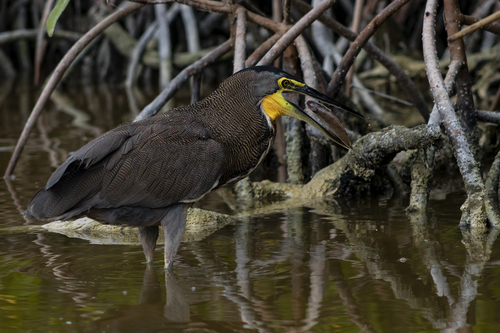
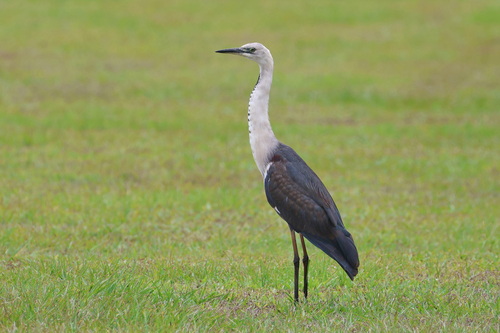
The fasciated tiger heron, with the scientific name Tigrisoma fasciatum (Such, 1825), measures 23–25 inches (58–64 cm) in length, making it the smallest of the three recognized tiger heron species. Adult fasciated tiger herons have a black crown, and slaty gray coloring on the sides of the face. The neck and upperparts are black, marked with widely spaced, fine pale buff stripes. The abdomen ranges from grayish-cinnamon to warm brown, and the flanks are gray. Compared to other tiger herons, this species has a shorter, stouter beak that is black on the upper mandible and yellowish-green on the lower mandible, with a slightly arched culmen. The irides are yellow.
The fasciated tiger heron occurs primarily in foothill habitats alongside rocky, fast-flowing streams. Its geographic range extends from Costa Rica through northwestern Argentina, southeastern Brazil, and Guyana; it has been recorded as a vagrant in Nicaragua. While it can be found from sea level up to 2,400 feet (730 m), it generally occupies higher elevations than the rufescent tiger heron in areas where both species are present.
When hunting along rivers, the fasciated tiger heron stands on the shore or on rocks in the watercourse with its neck partially extended. It preys mainly on fish, which it catches by stabbing with its beak, and it also feeds on large insects.