About Tigridia pavonia (L.f.) Redouté
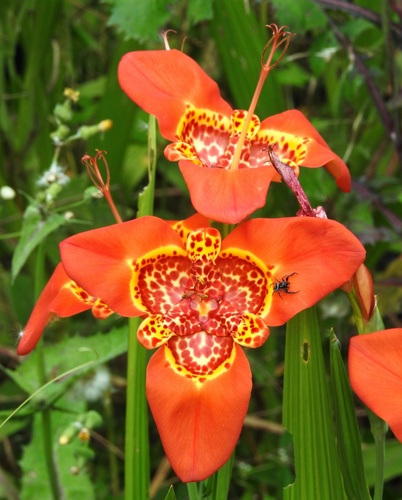
Tigridia pavonia (L.f.) Redouté is a flowering plant species belonging to the iris family Iridaceae. Its common names are jockey's cap lily, Mexican shellflower, peacock flower, jaguar flower, tiger iris, and tiger flower. The Aztecs of Mexico named this flower ocēlōxōchitl, which means "jaguar flower". The Inga and Kamëntšá peoples of Colombia call this flower watsimba. It is a bulbous herbaceous perennial that blooms in summer, and is native and widespread across most of Colombia, El Salvador, Guatemala, Honduras, and Mexico. It is also naturalized in Ecuador and Peru. Its leaves are narrow and lance-shaped. Its three-petalled flowers come in a range of colour combinations, with strongly contrasting central markings. The flower's three sepals are larger, reaching up to 7.5 cm (3.0 in) long, and give the entire flower a total width of 15 cm (5.9 in). Flowers open early in the morning and close before dusk, and bloom in succession throughout the summer. Plants will bloom in their first year after sowing. Tigridia pavonia is cultivated as an ornamental plant. It grows best in a sheltered location with full sun, in sandy, fertile soil. Different sources list varying hardiness temperatures for the species: many state it is hardy to temperatures as low as −12 °C (10 °F), while others only list it as hardy to 5 °C (41 °F). Most authorities recommend lifting and storing the corms over winter in colder regions. The roasted bulbs of this plant are edible, and have been used by American Indians and Indigenous peoples of Mexico; they have a flavour similar to chestnut. In the Sibundoy Valley of Colombia, the local Inga and Kamëntšá Indigenous communities already know this flower as watsimba, and use its bulbs in a variety of recipes. Indigenous women in this valley also use Tigridia pavonia bulbs to make a reddish dye for makeup and clothes. The species is widely used as chicken feed in these communities, who consider it produces better quality meat and eggs than other feed options. For culinary use, watsimba is also used as a substitute for potatoes. Tigridia pavonia contributes to food security in the Indigenous polyculture gardens called chagras maintained by these communities: if other staple crops do not produce well, the flower bulbs can be harvested for food. The Sibundoy Valley Indigenous communities also use the flowers of this species for medicinal purposes, prepared in a range of infusions and poultices, most often to treat acid reflux, gastritis, and abdominal distension. The aphid species Aphis newtoni may be found growing on Tigridia pavonia plants.