About Tiarella trifoliata L.
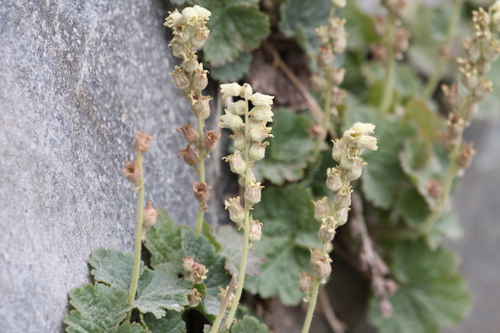
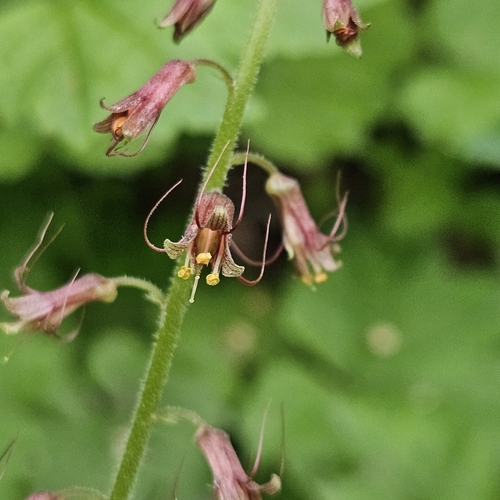
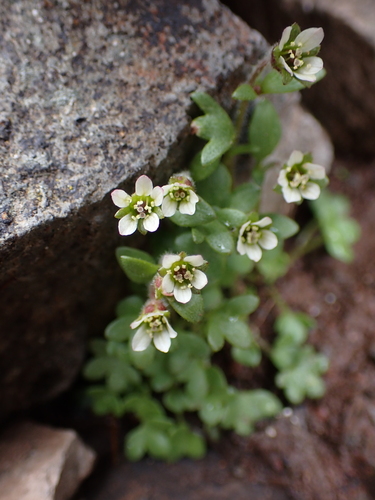
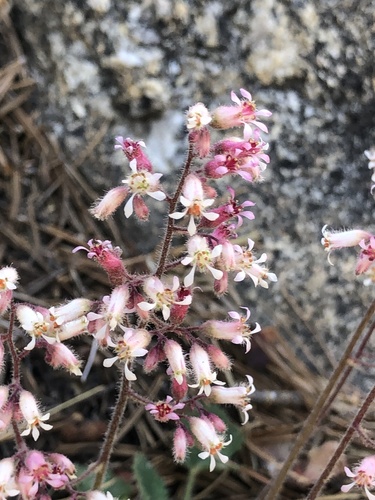
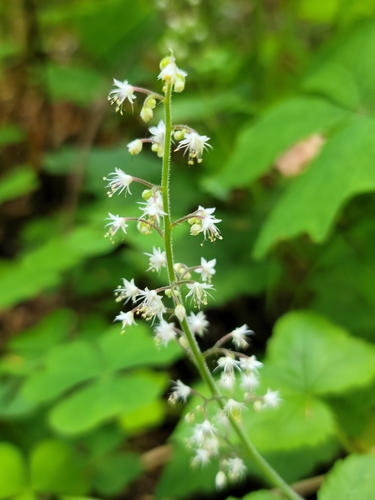
Tiarella trifoliata L. is a perennial dicotyledonous herb that blooms in late spring. Its flowers are white, bell-shaped, and borne on an elongated, leafless panicle. Calyx lobes measure 1.5–2.5 mm, while petals measure 3–4 mm. Basal leaves range from 15–80 mm in length and up to 120 mm in width, and are either trifoliate or palmately 3- to 5-lobed. Cauline leaves are rare and much smaller than basal leaves. Three varieties of Tiarella trifoliata are recognized. The typical variety, Tiarella trifoliata var. trifoliata, has petiolate, trifoliate leaves with three leaflets per leaf. Cut-leaved foamflower, Tiarella trifoliata var. laciniata, also has petiolate trifoliate leaves, but differs from the typical variety in having deep lobes that extend more than half the length of the leaflet. One-leaf foamflower, Tiarella trifoliata var. unifoliata, has sessile, simple leaves, and is only rarely trifoliate. In western North America, Tiarella trifoliata grows in shaded, moist habitats, including sometimes dense woods, at elevations up to 1,900 m (6,234 ft). Its overall range extends from northern California through western Canada north to Alaska, and east to Montana. The varieties of Tiarella trifoliata have overlapping ranges across this overall distribution. Tiarella trifoliata var. laciniata occurs in British Columbia, Oregon, and Washington. Tiarella trifoliata var. trifoliata occurs in Alberta, British Columbia, Alaska, California, Idaho, Montana, Oregon, and Washington. Tiarella trifoliata var. unifoliata occurs in Alberta, British Columbia, Alaska, California, Idaho, Montana, Oregon, and Washington. T. trifoliata var. trifoliata and T. trifoliata var. unifoliata range as far north as Alaska, while T. trifoliata var. laciniata only ranges as far north as Vancouver Island in British Columbia.