About Tiarella cordifolia L.
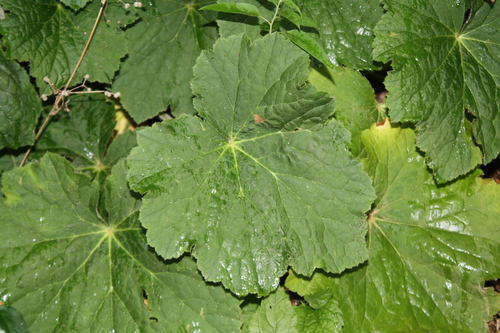
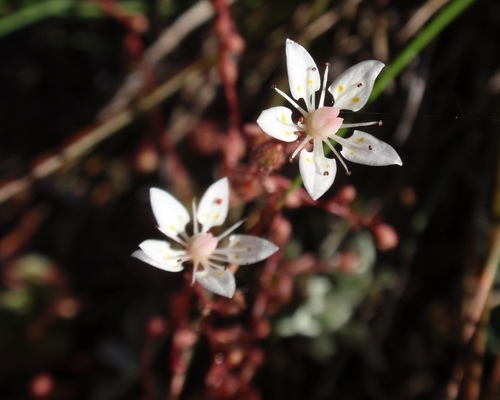
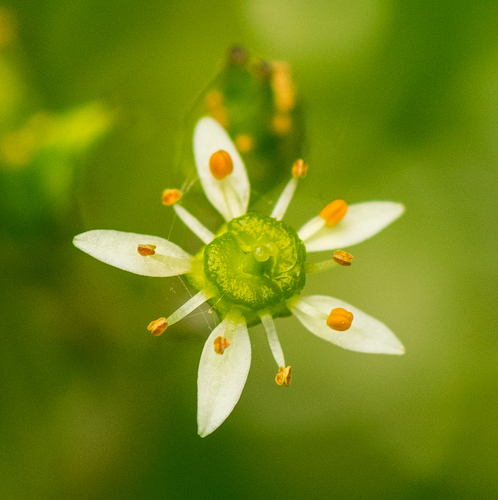
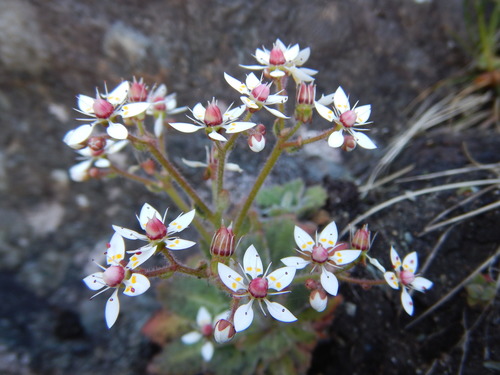
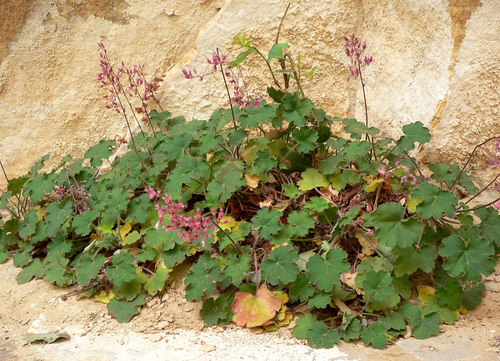
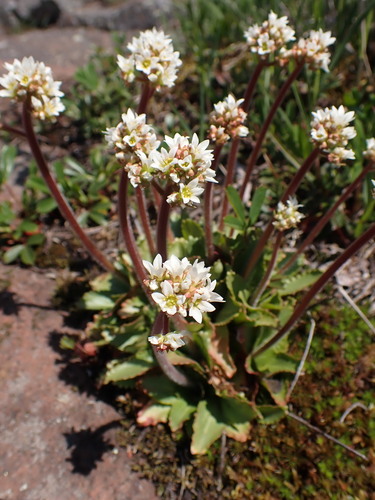
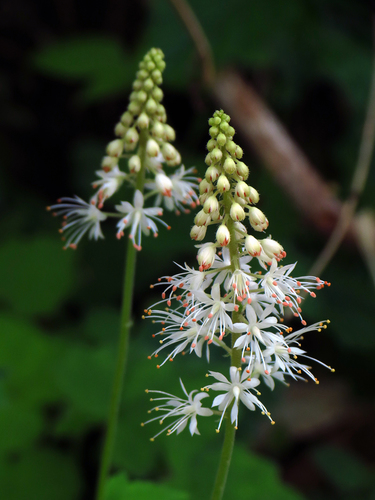
Tiarella cordifolia sensu lato is a herbaceous, perennial plant with a scaly horizontal rhizome. Its heart-shaped basal leaves grow on hairy stalks up to 20 cm (8 in) long, and uniformly scattered hairs cover both sides of the leaf blade. The erect flowering stem is 15–40 cm (6–16 in) long, and bears a terminal raceme containing 15–50 flowers. The flowers are small, white, and feathery, which gives the entire flower cluster a fuzzy appearance. Each flower has 5 sepals, 5 petals, and 10 long, slender stamens that are longer than the petals. The plant produces two unequal seed capsules that split along their inner seams to release several pitted seeds. Some other Tiarella species (T. austrina, T. stolonifera) produce leafy stolons, and some (T. nautila, T. austrina) have stem leaves. Some species (T. austrina, T. nautila, T. wherryi) have relatively large basal leaves with an extended terminal lobe. Tiarella cordifolia sensu stricto does not have any of these characteristics. The heart-shaped basal leaves of Tiarella cordifolia sensu lato are similar in appearance to leaves of species in other genera. For example, Tiarella is sometimes confused with Mitella diphylla, a closely related species that shares a similar range and habitat. When a plant does not have enough flowering structures visible to confirm identification, the orientation of hairs on the basal leaf stalk can be used to tell the two species apart. All eastern North American Tiarella species have dense, spreading outward-facing hairs angled at 90 degrees, in a range of lengths, while M. diphylla has sparse, long backward-facing retrorse hairs angled at 45 degrees or less along its basal leaf stalk. To positively identify Tiarella cordifolia sensu stricto, all of the following key features must be verified, in any order: stolons are always absent, basal leaves are usually about as long as they are wide, basal leaf lobes are usually obtuse to rounded with no extended terminal lobe, and the flowering stem has no leaves or foliaceous bracts. If the plant has a stolon, it is not Tiarella cordifolia sensu stricto, and is instead either Tiarella stolonifera or Tiarella austrina. Except for the presence of a stolon, T. stolonifera shares all of the key features of T. cordifolia sensu stricto, which can make distinguishing the two species difficult. Tiarella cordifolia sensu stricto is also similar to Tiarella wherryi, and the two differ only in the form of their basal leaves. In eastern North America, Tiarella cordifolia sensu lato is wide-ranging: it occurs from northeastern Wisconsin across southeastern Canada to Nova Scotia, and extends southward through the Appalachians into Alabama and Mississippi. It is found in the Canadian provinces of New Brunswick, Nova Scotia, Ontario, and Québec, and in the U.S. states of Connecticut, Georgia, Kentucky, Maine, Maryland, Massachusetts, Michigan, New Hampshire, New Jersey, New York, North Carolina, Ohio, Pennsylvania, Rhode Island, Tennessee, Vermont, Virginia, West Virginia, and Wisconsin. Tiarella cordifolia sensu stricto grows in moist forests, coves, rock outcrops, and well-drained bottomlands. Its range is narrowly confined to the U.S. East Coast from Maryland southward through Virginia and the Carolinas, and into Georgia. Documented county occurrences are as follows: Georgia: Clarke, Elbert, Jackson; Maryland: Charles, Montgomery, Prince George's; North Carolina: Alamance, Alexander, Alleghany, Avery, Burke, Cabarrus, Caldwell, Catawba, Chatham, Cleveland, Cumberland, Davie, Durham, Forsyth, Gaston, Granville, Guilford, Harnett, Iredell, Johnston, Lee, Lincoln, McDowell, Mecklenburg, Montgomery, Orange, Randolph, Rockingham, Rowan, Rutherford, Stanly, Stokes, Surry, Union, Wake, Wilkes, Yadkin; South Carolina: Abbeville, Cherokee, Chester, Edgefield, Fairfield, Kershaw, Lancaster, Laurens, McCormick, Newberry, Richland, Spartanburg, Union, York; Virginia: Albemarle, Amelia, Amherst, Appomattox, Augusta, Bedford, Botetourt, Brunswick, Buckingham, Campbell, Caroline, Charlotte, Chesterfield, Culpeper, Cumberland, Fairfax, Fauquier, Fluvanna, Franklin, Goochland, Halifax, Henrico, Henry, James City, Lunenburg, Mecklenburg, Nelson, Patrick, Pittsylvania, Powhatan, Prince Edward, Roanoke, Spotsylvania, Stafford, Sussex. The range of Tiarella cordifolia sensu stricto does not significantly overlap with the ranges of other Tiarella species. That said, the ranges of T. cordifolia and T. stolonifera are immediately adjacent along the Blue Ridge Mountains in western Virginia and western North Carolina, and both species occur in a handful of North Carolina counties (Alleghany, Avery, Burke, McDowell, Wilkes). Similarly, the ranges of T. cordifolia and T. austrina are adjacent in southwestern North Carolina and northwestern South Carolina. In northeastern Georgia, the ranges of T. cordifolia and T. nautila overlap in Jackson County. Tiarella cordifolia sensu lato flowers from March through July. A wide range of insects including bees, butterflies, and syrphid flies may act as pollinators, but there is no detailed published information available on its pollination. Tiarella cordifolia has received the Royal Horticultural Society's Award of Garden Merit. It spreads effectively via rhizomes, unlike other Tiarella cultivars, and does not have the invasive growth habits of many commonly used groundcovers. The cultivar Tiarella cordifolia 'FM Mooberry' is named after F. M. Mooberry of the Brandywine Conservancy.