About Thysanotus racemoides Sirisena, T.D.Macfarl. & Conran
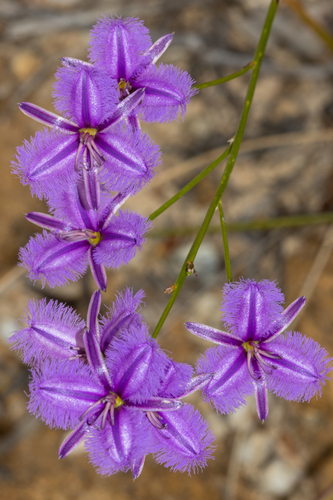
Thysanotus racemoides Sirisena, T.D.Macfarl. & Conran is a perennial herb. It has a horizontal, more or less cylindrical rhizomatous rootstock, along with fibrous roots. Leaves are often completely absent; when present, only a few grow at the plant's base, and they are subterete, measuring 60–80 mm (2.4–3.1 in) long. Flowers are most often borne in pairs within umbels, and rarely grow in groups of up to four. Each individual flower sits on an erect pedicel that is 5–6 mm (0.20–0.24 in) long. Its perianth segments range in color from pink to mauve, and measure 12–15 mm (0.47–0.59 in) long. The petals have a fringe that is 3–4 mm (0.12–0.16 in) long, and the plant produces six stamens: the outer three anthers are 3–6 mm (0.12–0.24 in) long, while the inner three anthers measure 4 mm (0.16 in) long. Its style is curved, and measures 6–12 mm (0.24–0.47 in) long. Flowering takes place from November to January. The plant's seed capsules are more or less spherical, about 4–7 mm (0.16–0.28 in) long and 3–5 mm (0.12–0.20 in) in diameter, and its seeds have a straw-coloured aril. This species of Thysanotus is restricted to deep sands in inland western Victoria, eastern South Australia, and sandplains and lateritic gravels on Kangaroo Island. It grows in a wide range of habitats, from dry forest to woodland and low heath. Within Victoria, it is found in the Big Desert, the Grampians, and near Anglesea.