About Thysanotus patersonii R.Br.
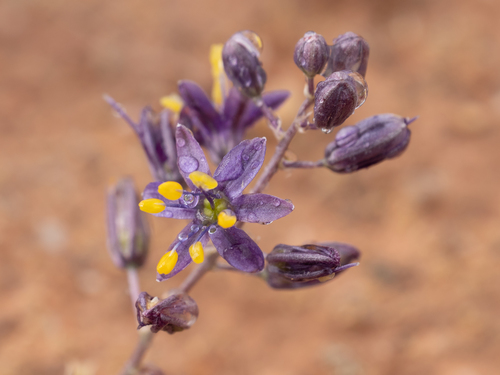
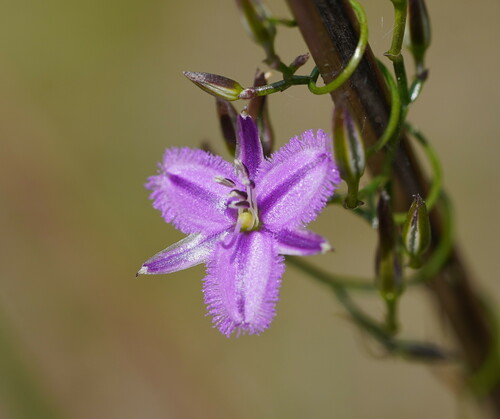
Thysanotus patersonii R.Br. (common name twining fringe-lily) is a leafless, twining perennial herb with tuberous roots. Its tubers are typically 2–5 cm (0.79–1.97 in) long. This species usually produces a single stem 10–100 cm (3.9–39.4 in) long: the stem is round in cross-section and hairy at the base, square in cross-section and hairless above. The stem either twines around surrounding vegetation or grows prostrate along the ground, and usually has many branches that reach 15–50 cm (5.9–19.7 in) in length. Flowers are most often borne singly on branches, attached by a 1–2 mm (0.039–0.079 in) long pedicel. Perianth segments measure around 8–10.5 mm (0.31–0.41 in) long. Sepals are linear to lance-shaped, 2–3 mm (0.079–0.118 in) wide, while petals are elliptic, 4–6 mm (0.16–0.24 in) wide, with a fringe 0.5–1 mm (0.020–0.039 in) long. There are six stamens, and all anthers are equally 2–6 mm (0.079–0.236 in) long, straight to slightly curved. The style is straight to curved, 3–4 mm (0.12–0.16 in) long. Flowering occurs between July and November. Seeds are roughly spherical, around 1 mm (0.039 in) in diameter, with a straw-coloured aril. Twining fringe-lily occurs in all Australian states and the Australian Capital Territory, but is not present in Queensland or the Northern Territory. It grows in a wide variety of habitats, excluding tall forest and wet or saline communities. In Western Australia, it is widespread across the south-west. In South Australia, it is especially common in the state’s south-east. In New South Wales and the Australian Capital Territory, it is widespread, occurring mainly in inland districts west of the Braidwood, Bathurst and Warrumbungle areas. It is widespread and locally common throughout Victoria, except for the far east of the state. Strips of this plant are used by the red-eared firetail (Stagonopleura oculata), a small bird native to Southwest Australia, to build its elaborate nests. This species is used in urban landscapes and gardens, particularly as a rockery specimen. It is grown from seed, favours full sun and free drainage, and will trail out from rocks or loosely spiral up neighbouring plants. It produces abundant flowers that appear through spring and summer.