About Thysanotus multiflorus R.Br.
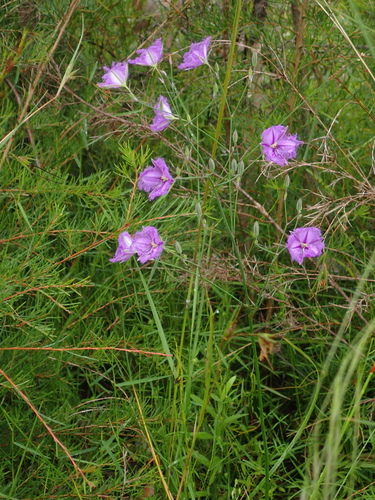
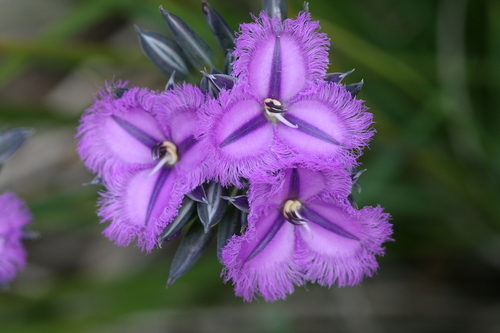
Thysanotus multiflorus, commonly known as many-flowered fringe lily, is a tufted perennial herb. It has a small rootstock enclosed by old leaf bases, and fibrous roots. This species produces between 3 and 30 leaves per plant; the leaves are linear to narrowly lance-shaped, flat to somewhat channelled, and measure 70–570 mm (2.8–22.4 in) long by 2–5 mm (0.079–0.197 in) wide. Flowers are typically arranged in a single umbel holding 4 to 60 purple flowers, and occasionally a second umbel grows 50–100 mm (2.0–3.9 in) below the first. Each flower sits on a pedicel 6–28 mm (0.24–1.10 in) long. The perianth segments are 7–17 mm (0.28–0.67 in) long; sepals are linear to narrowly lance-shaped (wider at the tip than the base) and 2.0–2.5 mm (0.079–0.098 in) wide, while petals are elliptic, 6–8 mm (0.24–0.31 in) wide, and edged with a fringe 3.5–5 mm (0.14–0.20 in) long. There are three stamens, with 5 mm (0.20 in) long curved anthers. The style is around 6 mm (0.24 in) long and curves in the opposite direction to the anthers. Flowering occurs from August to December or January. The seeds are roughly cylindrical, 2 mm (0.079 in) long and 1.5 mm (0.059 in) in diameter, with a stalked yellow aril. Many-flowered fringe lily grows in humus-rich sandy soils. Its habitat includes coastal banksia scrub forest on sand, as well as Eucalyptus marginata-Corymbia calophylla forest and Eucalyptus staeri forest. It occurs south-east of a line running from the Avon River to Cape Riche, within the Avon Wheatbelt, Esperance Plains, Geraldton Sandplains, Jarrah Forest, Swan Coastal Plain and Warren IBRA regions of south-western Western Australia.