About Thysanotus juncifolius (Salisb.) J.H.Willis & Court
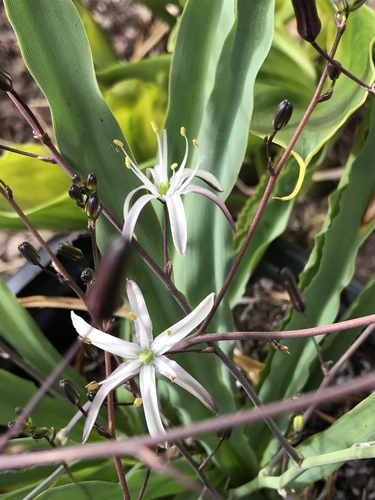
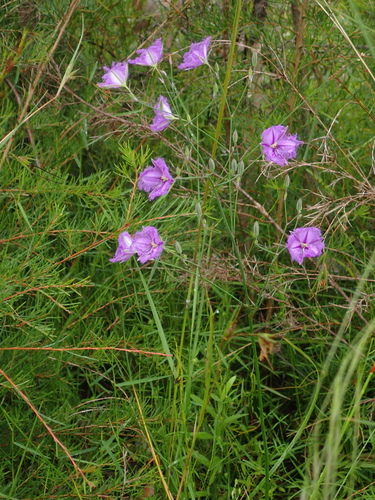
Thysanotus juncifolius is a herbaceous plant that has a horizontal rhizome 10–30 mm (0.39–1.18 in) long and fibrous roots, and typically grows to a maximum height of around 60 cm (24 in). It produces up to three linear leaves, each 60–250 mm (2.4–9.8 in) long, annually; leaves are occasionally absent from the plant. Its striated flowering stems are 15–65 cm (5.9–25.6 in) long, and sometimes have two or three branches. Up to five pink to mauve flowers are arranged in up to five umbels at the ends of the stems, with each flower growing on a pedicel 6–11.5 mm (0.24–0.45 in) long. The tepals of the flower are 10–14 mm (0.39–0.55 in) long; the sepals are 1.5–2 mm (0.059–0.079 in) wide, while the petals are 4–5 mm (0.16–0.20 in) wide with a fringe that measures 3.0–4.5 mm (0.12–0.18 in) long. The species has six stamens, all shorter than the petals. The three outer anthers are straight and 2–3 mm (0.079–0.118 in) long, while the inner anthers are curved and 6–8 mm (0.24–0.31 in) long. Flowering takes place between September and March. The fruit is a capsule roughly 4 mm (0.16 in) in diameter, holding cylindrical seeds that are 1.5 mm (0.059 in) long and 1 mm (0.039 in) in diameter, with a yellowish aril. This species grows in a variety of habitats, ranging from tall forest to open mallee and heath. It occurs in soil types from sandy gravel and shallow loam to deep sand and gravel. Its distribution covers south-eastern Queensland, coastal regions near Sydney, inland areas as far as the Blue Mountains, the far east of Victoria, and the Ninety Mile Desert, Fleurieu Peninsula, Eyre Peninsula, and Kangaroo Island in South Australia.