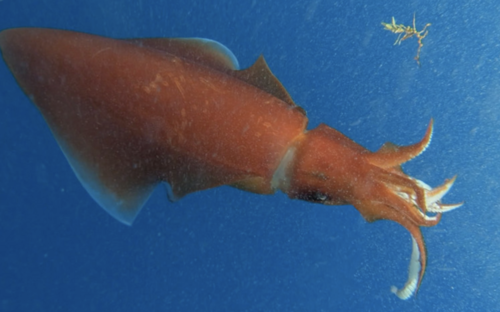
About Thysanoteuthis rhombus Troschel, 1857
Thysanoteuthis rhombus can be distinguished by the structure of its suckers: its arms have two series of suckers, while its tentacular clubs have four. This species lacks photophores. It gets its name from its fins, which extend along the mantle in equal lengths, creating a rhombus-like shape. Individuals of this species can grow to a mantle length of up to 100 centimetres (39 in) and reach a maximum weight of 30 kilograms (66 lb), with an average weight of around 20 kilograms (44 lb). The total lifespan of T. rhombus is 1 year. Males reach sexual maturity when their mantle length is between 400–550 millimetres (16–22 in), at an age of 170 to 200 days. Females reach maturity at a mantle length between 550–650 millimetres (22–26 in), at an age of 230 to 250 days. T. rhombus has a relatively low population density, which has led to a trait unique among squids: male-female pairs of the same size stay together from the juvenile stage until death, meaning the species is monogamous. Pairing of males and females happens at an immature stage when mantle length is less than 100 millimetres (3.9 in), and pairs remain monogamous after pairing. Mating takes place in a head-to-head position, where the male uses his hectocotylus to attach to the female's buccal membrane to transfer spermatophores. In tropical waters, spawning occurs year-round and lasts for 2–3 months. In temperate regions, spawning is restricted to summer or early autumn, when warmer currents are present. T. rhombus is an intermittent spawner that produces multiple batches of eggs in succession over the spawning period. During spawning, females release a gel-like secretion from their nidamental glands, similar to the Japanese flying squid. This secretion absorbs water and swells, and the female molds the engorged secretion into a cylinder. Next, the female's oviductal glands produce two mucous threads, each holding a single row of eggs. These threads fuse into a single cord with a double row of eggs inside the mantle cavity. The fused egg cord or mass is expelled into the water through the funnel, where the eggs are fertilized by sperm that has been attached to the female's buccal membrane in her seminal receptacles. The fertilized egg cord is then wound onto the gel cylinder. A female can produce 8 to 12 egg masses if she properly uses all her vitelline oocytes.

