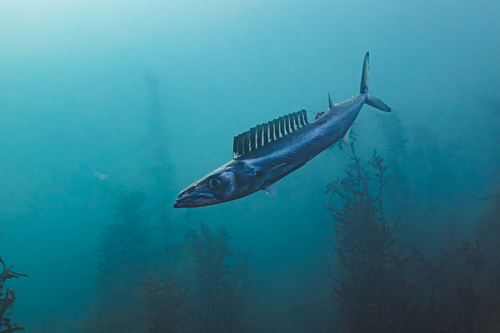
About Thyrsites atun (Euphrasen, 1791)
This species, currently the only known member of its genus, has the scientific name Thyrsites atun (Euphrasen, 1791), and is also referenced under synonyms Leionura atun and L. atun. This fish can reach a maximum length of 200 cm (79 in) in standard length, though most individuals do not exceed 75 cm (30 in) SL. The maximum recorded weight for this species is 6 kilograms (13 lb). It has 19 to 21 dorsal spines, around 113 dorsal rays, 1 anal spine, 10 to 13 anal rays, and 35 vertebrae. Its body is elongate and compressed, with a single lateral line that runs along the upper body before curving ventrally. Its dorsal body is blue-black, with a paler belly, and the first dorsal fin is black. While it is commonly believed that a bite from this fish contains an anticoagulant, this claim is not supported by scientific research. It is a very important species for commercial fisheries, and is also a popular game fish. This fish is widely distributed across colder Southern Hemisphere waters, with a circumglobal coastal distribution. In the southwest Atlantic, it occurs from Uruguay, Argentina, and Tierra del Fuego. In the eastern Atlantic, it is found at Tristan da Cunha and off South Africa. In the western Indian Ocean, it occurs off South Africa and around St. Paul and Amsterdam islands. In the eastern Indian Ocean, it is found around Tasmania and the southern coast of continental Australia. In the southwest Pacific, it occurs off New Zealand and along Australia's southern coast. In the southeast Pacific, it is found from southern Peru, Chile, and Tierra del Fuego. Along the African coast, it ranges from Moçâmedes in northern Angola, along the coasts of Namibia, and the Northern Cape and Western Cape provinces of South Africa, as far east as Algoa Bay; most of the African population occurs between the Kunene River and Cape Agulhas. Although this species is distributed circumglobally, it lives in coastal waters, and regional populations are often split into discrete stocks. Three stocks are recognized off New Zealand, the Australian population may contain between three and five separate stocks, and the southern African population is thought to split into a northern and a southern stock with limited north-to-south mixing. Thyrsites atun lives near continental shelves or around oceanic islands, and feeds on small fish like anchovy and pilchard, crustaceans, cephalopods, and other invertebrates. For the South African population, 50% of individuals reach sexual maturity at 3 years of age, at a fork length of about 73 cm (29 in). Spawning takes place during winter and spring, from May to November with a peak from June to October, along the continental shelf break of the western Agulhas bank and the South African west coast, at depths between 150 and 400 m (490 and 1,310 ft). Eggs and larvae are carried by ocean currents to the primary nursery area north of Cape Columbine and the secondary nursery area east of Danger Point, where juveniles stay until they reach maturity. Thyrsites atun eggs hatch around 50 hours after fertilization. Larvae initially feed on phytoplankton, and begin active feeding when they reach 3.5 mm (0.14 in) long, around 3 to 4 days after hatching. When larvae grow to about 8 mm long, they start eating the larvae of other fish, which are most abundant in this region during spring and summer. After their first year of growth, individuals reach between 33 and 44 cm (13 and 17 in) in length. The main prey of the South African population are the clupeoid fishes Sardinops sagax (sardine) and Engraulis japonicus (anchovy); this species is a major predator of these fish in the southern Benguela ecosystem, and consequently affects zooplankton populations further down the food chain. Juveniles smaller than 24 cm (9 in) mostly feed on the lanternfish Lampanyctodes hectoris, the euphausid Euphausia lucens, and the amphipod Themisto gaudichaudii. Individuals between 25 and 49 cm (10 and 19 in) feed on lanternfish, T. gaudichaudii, anchovies, and sardines. Subadults from 50 to 74 cm (20 to 29 in) feed on anchovy, euphausids, and sardines. Adults larger than 75 cm (30 in) feed primarily on sardines and anchovies. Offshore, this fish eats almost exclusively pelagic and demersal teleosts, including sardines, roundherring, and hake of the genus Merluccius. Larger adults consume more hake, sardine, and horse-mackerel (Trachurus trachurus). Stomach content analysis has identified many other species, including a range of invertebrates, as less frequent prey. Thyrsites atun, commonly called snoek, is widely used as a food fish. It is sold fresh, smoked, canned, and frozen, and can be cooked by frying, broiling, baking, and microwaving. It is most often prepared by grilling, frying, or smoking. In South Africa, it is frequently braaied, a local style of barbecue. In regions like Japan, it is made into fishcakes. Snoek is an oily fish that is extremely bony, though the bones are large and can be easily removed from cooked fish. It has very fine, almost undetectable scales, so scaling the fish is not necessary during cleaning. It has a very distinctive flavor. In South Africa, snoek is caught and consumed along the country's west and southwestern coasts. Commercially processed snoek is sold throughout South Africa, usually as packaged smoked snoek, snoek pâté, and canned snoek. Fresh snoek is usually purchased directly from quayside sellers. In and around Cape Town, this occurs at locations including Hout Bay, Kalk Bay, and Gordon's Bay. Up the west coast and down toward Mossel Bay, much of the local catch is salted and air-dried for local consumption. Fresh snoek is typically barbecued over an open grill, or wrapped in aluminum foil with butter and herbs and served with boiled sweet potatoes and tamatiesmoor, a fried hash of chopped tomatoes, onions, garlic, and herbs. Another popular dish is kedgeree made with smoked snoek. In the Cape Malay community, snoek forms the base of many traditional dishes, including smoorsnoek, snoekbredie (a stew), fish bobotie, and snoek pâté. In subsistence fishing communities along the Cape's west coast, snoek and other fish species are cleaned, sliced, packed flat, and heavily salted with coarse salt. After sitting salted for a few days, the fish is hung to air-dry. Dried snoek is a staple food for these communities and also serves as a useful trading commodity. Just as Portuguese cooks use dried cod to make bacalhau, these communities soak the dried fish in multiple changes of fresh water until it softens, before adding it to soups, stews, and casseroles made with local indigenous vegetables, typically served with staples like potatoes, yams, or rice. While snoek is very popular in regions like South Africa, it was unpopular with British residents during and immediately after the Second World War, when rationing was in place, because it was considered a food of deprivation. Large quantities of canned snoek, alongside canned Australian barracuda, were imported into Great Britain, and government marketing efforts for the product were unsuccessful and likely had a negative effect on its reputation. In the end, the vast majority of 10 million tins of South African snoek, along with 9 million tins of Australian barracuda, were sold off as cat food. In the United States, fresh Pacific sierra imported from Chile or Mexico is sometimes sold as snoek.

