About Thyridopteryx ephemeraeformis (Haworth, 1803)
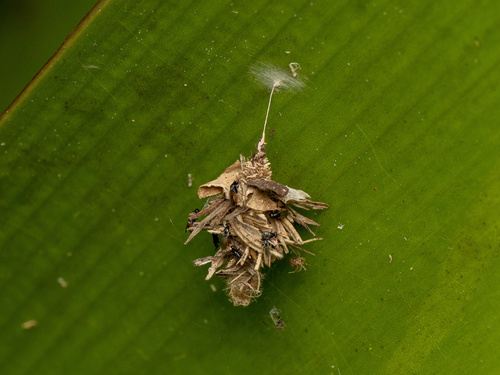
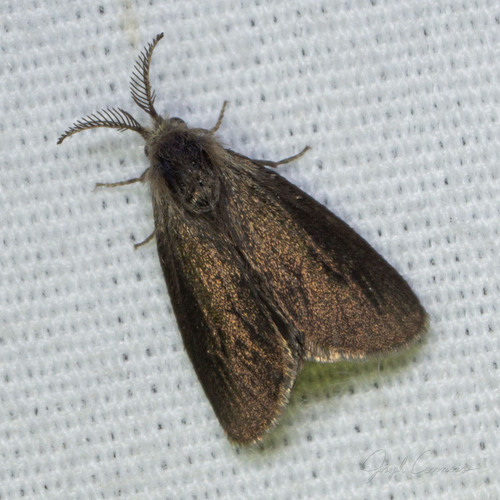
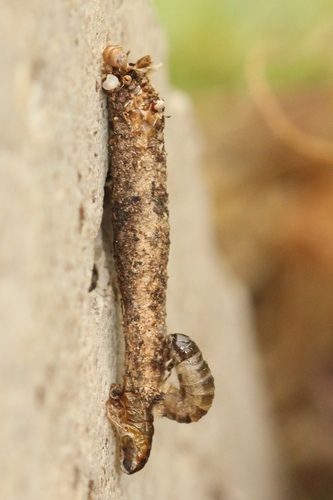
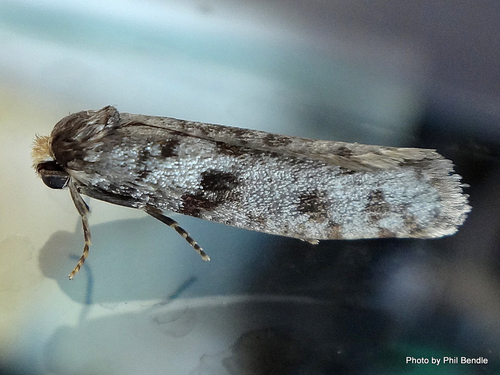
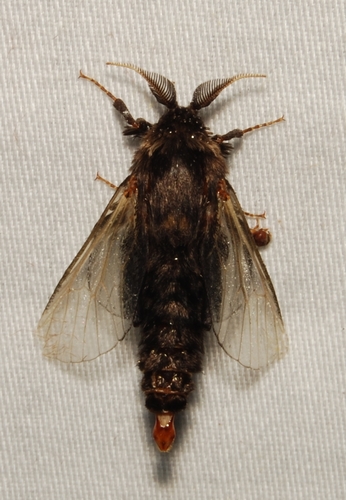
Thyridopteryx ephemeraeformis, commonly called the evergreen bagworm, bagworm, eastern bagworm, common bagworm, common basket worm, or North American bagworm, is a species of moth. In its larval stage, it spins a cocoon (called a case) that it decorates with pieces of plant material from the trees it feeds on. The evergreen bagworm's case grows to over 6 centimeters, is tapered, and is open at both ends. Newly hatched larvae are blackish in color; as they grow, they turn brown to tan, with black mottling. Their heads and thorax develop a yellow tint as they reach a full adult larval length of 24 to 32 millimeters. Adult males resemble bees, with a 25 millimeter wingspan of transparent wings (the genus name comes from thuris meaning window and pterux meaning wing) and black furry bodies. Adult females are maggot-like, with soft yellowish-white bodies 19 to 23 millimeters long, and small tufts of hair near the tip of the abdomen. The species' cream-colored eggs measure 0.75 millimeters in diameter. Evergreen bagworms thrive in the eastern United States, ranging west to Nebraska, north into New England, and south along the Gulf of Mexico through Texas. Populations have also been recorded in other countries including South Africa, Croatia, and northeastern Iran. Large populations in forested areas are uncommon, but in urban areas with few predators, evergreen bagworms often grow to high numbers. When disturbed, larvae pull their heads back into their case and close the front opening. When larvae reach maturity, they may stay on their host tree or drag their case to a nearby spot before attaching it to enter the pupa stage. Larvae feed on the leaves and buds of trees. Arborvitae and red cedar are their most preferred host trees; they will also feed on cypress, juniper, pine, spruce, apple, birch, black locust, elm, maple, poplar, oak, sycamore, willow, and more than 100 other tree species. Evergreen bagworms are commonly parasitized by ichneumonid wasps, most notably Itoplectis conquisitor. Their predators include vespid wasps, hornets, woodpeckers, and sapsuckers; woodpeckers and sapsuckers can feed on larvae from inside their cases. Eggs hatch between early April and early June, with hatching occurring earlier in the southern parts of the species' range. Larvae emerge from the dead body of their mother, which remains inside her case. Newly hatched larvae exit through the bottom of the hanging case, then lower themselves down on a strand of silk. Wind often carries the larvae to nearby plants, where they begin building their own new case from silk and fecal material, before adding pieces of leaves and twigs from their host plant. When larvae reach full maturity in mid-August, they wrap silk around a tree branch, hang from the branch, and pupate head-down. The silk is strong enough to strangle and kill the branch as the branch grows over several years. Adult males complete their moth development after four weeks, then leave their pupal cases to search for females to mate. The female never leaves her cocoon, so the male must mate with her through the open end at the back of her case. Females have no eyes, legs, wings, or antennae, cannot eat, but produce a strong pheromone to attract mates. After the female dies, hundreds to several thousand eggs remain inside her body. Her offspring hatch, then pass through her body, her pupal shell, and her case over several months, before emerging to begin building their own cases. After emergence, the empty pupal case can still be found, filled with the yellow leftover remains of eggshells. Evergreen bagworms have a voracious appetite and are considered a serious pest. Infestations damage host tree foliage, and can kill the tree if left untreated. If an infestation is detected early enough, cases from the previous year can be removed by hand before the end of May. Cases are easiest to spot in the fall after they turn brown, especially on evergreen trees. A variety of control methods are used for infestations, including bacterial sprays such as Bacillus thuringiensis (Bt) and Spinosad, and stomach insecticides such as carbaryl (Sevin).