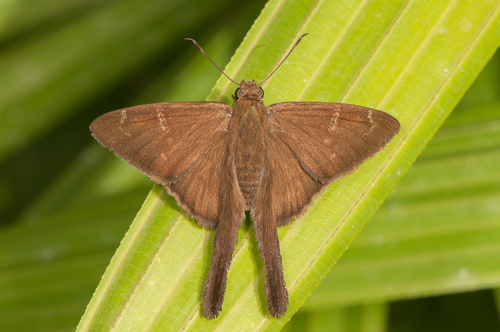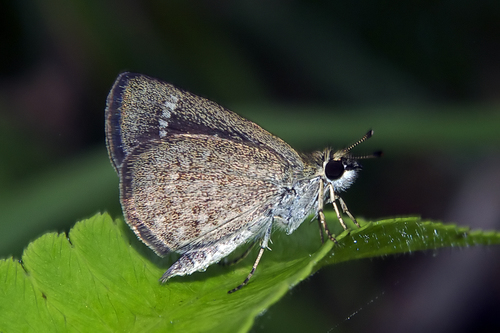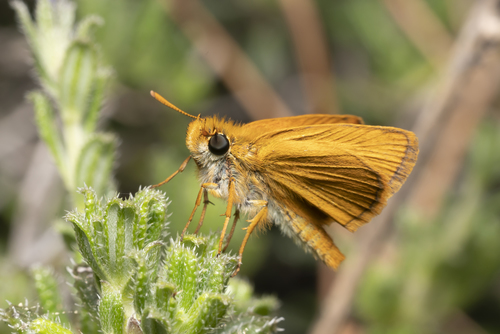
About Thymelicus acteon christi Rebel, 1894
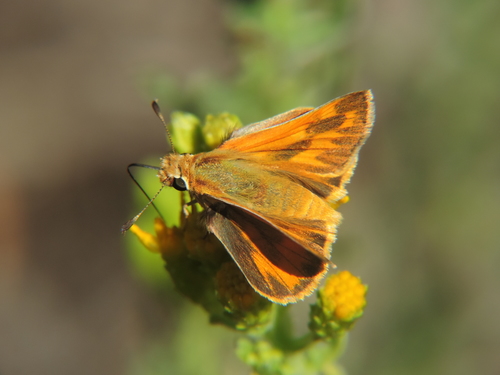
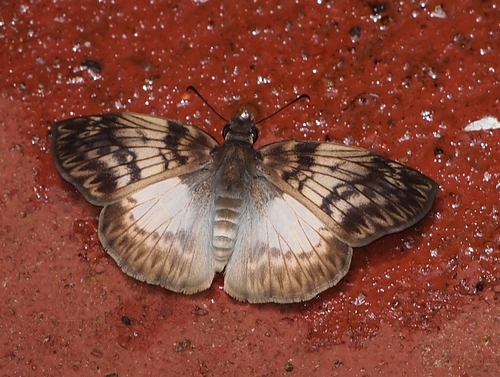
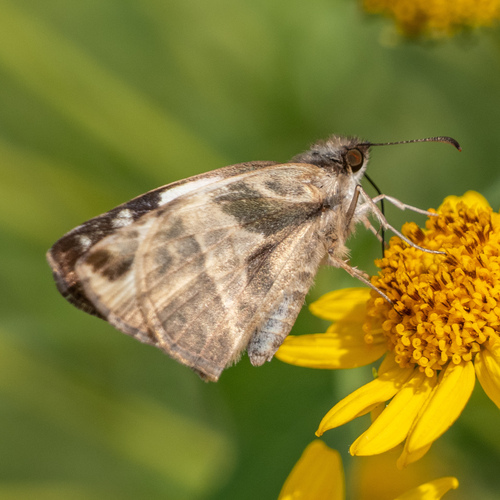
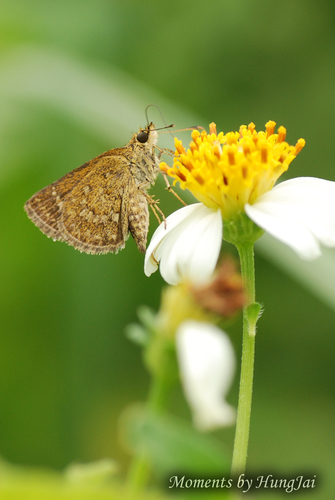
This subspecies is Thymelicus acteon christi Rebel, 1894, a Canary Islands endemic variant of the Lulworth skipper. The Lulworth skipper is one of Britain’s smallest butterflies, and the smallest member of the genus Thymelicus across Europe. Male Lulworth skippers have a wingspan of 24 to 27 millimetres (0.94 to 1.06 in), while females have a wingspan of 25 to 28 mm. It is the smallest and darkest of Britain’s five "golden" skippers, which also include the silver-spotted skipper (Hesperia comma), large skipper (Ochlodes sylvanus), small skipper (Thymelicus sylvestris) and Essex skipper (Thymelicus lineola). Beyond its small size, it is most easily distinguished by its dark, dun-coloured wings with olive-brown tinges; this darkening is especially prominent in males. Color and pattern variations occur across the species’ range: populations in north-west Africa have darker forewing and hindwing uppersides with greenish or greyish brown tints, similarly colored races are found in Spain, Elba, Crete, and other eastern Mediterranean islands, and the endemic Canary Islands subspecies T. acteon christi has defined yellow-orange markings on the uppersides of its forewings. The species shows clear sexual dimorphism: each forewing of females has a distinct circle of golden marks, often called "sun-ray" markings for their resemblance to the rays around the eye of a peacock feather. Males sometimes have these markings, but they are noticeably fainter. The Lulworth skipper occurs locally across southern and central Europe, Asia Minor, and North Africa, where its overall population is considered stable. Its numbers and range have declined severely in northern Europe; it is now extinct in the Netherlands, and this decline has led to the species being classified as vulnerable across Europe. Isolated populations in Armenia are also threatened, though the species has not yet been added to Armenia’s National Red List. It is also listed as threatened under the United Kingdom Biodiversity Action Plan. In Great Britain, where the species reaches the northern limit of its range, its distribution is restricted to the southern coastline of Dorset. Here, both the population and range have changed little in recent decades, and the species is locally abundant. Most colonies are found on the coast between Weymouth and Swanage, and on the Purbeck Ridge, an inland line of chalk hills. Two additional outlying colonies exist at Burton Bradstock and on the Isle of Portland; the origin of the Portland colony is unknown, but it has been suggested to come from either natural colonisation or released specimens. There is evidence that the Lulworth skipper is now more abundant in Dorset than at any other point since its discovery in 1832. Although colonies once existed in Devon, the species has not been seen in the county outside of single records since the 1930s. Occurrence records exist for Cornwall, but they have not been verified as native colonies. The Lulworth skipper’s primary habitat is unfertilised calcareous grassland; in Britain this includes chalk downland, coastal grassland, and undercliffs. Tor-grass, the butterfly’s sole food plant and the plant where it lays eggs, is widespread across all these habitats. The species favours tall, ungrazed grass for oviposition and larval development. It has benefited from the move away from intensive sheep grazing over the last century, and from recent myxomatosis outbreaks among rabbit populations that would otherwise keep grass heights lower. However, evidence suggests low-intensity grazing is not harmful to the species, and may actually be beneficial by encouraging growth of the flowers that act as adult nectar sources. Female Lulworth skippers lay their eggs in rows of 5 to 6, though clutches as large as 15 have been recorded, on the flower sheath of Tor-grass (Brachypodium pinnatum). They prefer the dead sheaths of tall plants, and the care females take when selecting an egg-laying site is the only unusual feature of the species’ otherwise common breeding process. After hatching, the 2.5 cm (1 in) larva spins a compact cocoon at the site of the eggshell, and overwinters inside it until around the third week of April. At that point, the larva eats its way out by creating a small hole in the side of the sheath. The caterpillar then searches for tender Tor-grass blades, and feeds by chewing notches from the blade margins. During this stage, the caterpillar lives alone inside a tube made from the two edges of a grass blade bound together with silk. It spins a new, larger tube as it grows. Lulworth skipper caterpillars live in the warmest zone of a grass clump, at a height of 20 to 40 centimetres (8 to 16 in). The pupal stage lasts around two weeks, starting from the beginning of June and continuing until late July. The pupa forms inside a loose "nest" of silk and grass, spun deep within a tor grass tussock. Adult butterflies begin emerging in early to mid July, and finish emerging by mid September. Adults typically live five to ten days, which is the normal lifespan for a non-hibernating butterfly in this seasonal stage. Adults only fly in strong sunshine, and tend to form distinct colonies, the largest of which can hold up to 100,000 individuals.