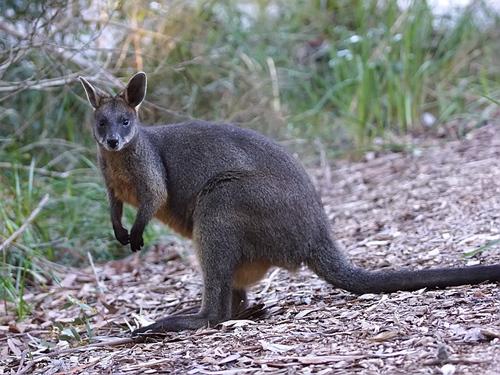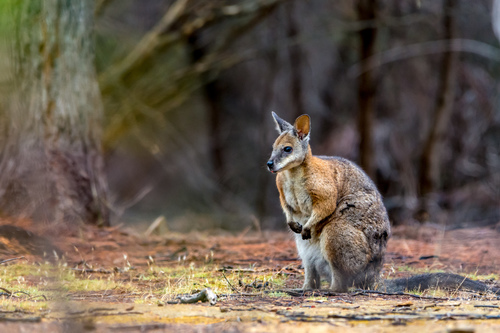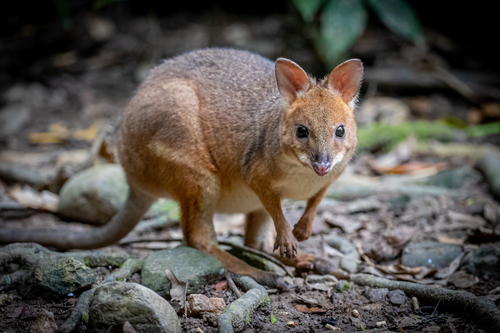
About Thylogale stigmatica (Gould, 1860)
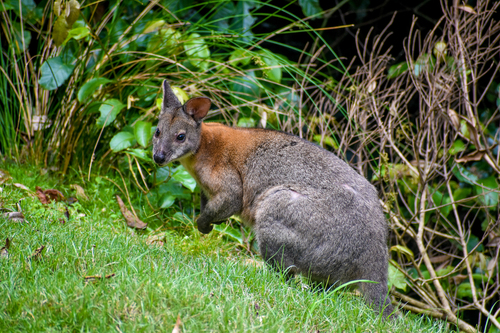
The red-legged pademelon (Thylogale stigmatica) is a species of small macropod found on the northeastern coast of Australia and in south-central lowlands of New Guinea. In Australia, it has a scattered distribution stretching from the tip of Queensland's Cape York Peninsula to around Tamworth in New South Wales. It is usually solitary, but may gather in groups when feeding. It occurs mostly in rainforests, where it is rarely seen. It is not considered threatened overall, but is classified as vulnerable within New South Wales. Its diet consists of fallen fruit, leaves, and grasses. It weighs 2.5 to 7 kg, has a body length of 38–58 cm, and a tail length of 30–47 cm. There are four recognized subspecies: T. s. stigmatica, found in the Cairns region of Queensland; T. s. coxenii, found in Cape York Peninsula; T. s. orimo, found in New Guinea; and T. s. wilcoxi, found in southern Queensland and New South Wales. Land clearance has caused a reduction in the red-legged pademelon's range, and its distribution is discontinuous, especially in the north where it is limited by the availability of vegetation that provides suitable cover. The species remains common in areas where intact habitat still exists, and it is not seriously disturbed by selective logging. While it prefers rainforest areas, it is also found near sclerophyll forest and dry vine scrubs. Extensive rainforest clearing has reduced its available habitat, but there are currently enough parks and reserves across its range to secure its overall status. Forest clearing can benefit the red-legged pademelon to a limited degree: a higher number of forest fragments provides the pademelons with more adequate pastures that supply sufficient food. Only two subspecies of red-legged pademelon inhabit Australia. The red-legged pademelon has a lifespan of 4 to 9.7 years. Lifespan is affected by predation and forest fire; after a forest fire, predation levels increase because of reduced forest cover. For red-legged pademelons, the gestation period is 28–30 days, and the oestrous cycle is 29–32 days. Mating takes place 2–12 hours after the birth of young. The sex of pouch young can be distinguished at 3 to 4 weeks old. Teat detachment happens at 13–18 weeks, ears become erect at 15–18 weeks, eyes open at 16–18 weeks, and hair becomes visible at 19–21 weeks. Young leave the pouch at 26–28 weeks old, and begin eating solid food approximately 66 days after leaving the pouch. Females reach sexual maturity at about 48 weeks old, while males reach sexual maturity at about 66 weeks. At birth, the tiny young is blind, has only undergone 3 to 6 weeks of development, and has barely developed limbs, but its forelimbs are well-enough developed for it to haul itself through its mother's belly fur to reach the pouch. Shortly after giving birth, the female pademelon becomes receptive to mating again, and will become pregnant again if mating is successful.