About Thyatira batis (Linnaeus, 1758)
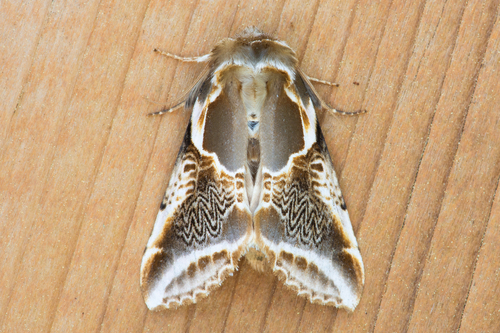
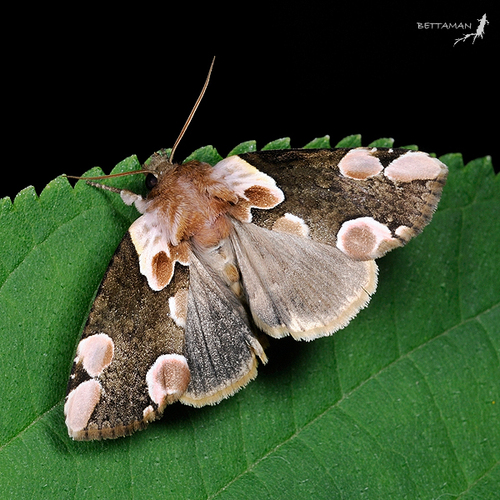
The peach blossom, Thyatira batis, is a moth species in the family Drepanidae. It was first formally described by Carl Linnaeus in the 10th edition of his Systema Naturae, published in 1758. This species is distributed across Europe, extending eastward through the Palearctic region to Japan and Mongolia, and it is fairly common in the British Isles. It is a distinctive moth: its forewings are brown, marked with five pink and white blotches that resemble the petals of peach blossom, which gives the species its common name. Its hindwings are buff and grey, and the species has a wingspan of 40 to 45 millimeters. Thyatira batis flies at night. In western Europe, its main flight period falls in June and July, and sometimes a partial second brood emerges in late August and September. The flight season noted here applies specifically to the British Isles, and it may differ in other parts of the species' range. Both adult moths are attracted to light and sugar. The larva is brown with white markings, and has several humps along its back. Like many other drepanids, it raises both ends of its body when at rest. The larvae feed on various species in the genus Rubus. This species overwinters in the pupal stage.