About Thuridilla vataae (Risbec, 1928)
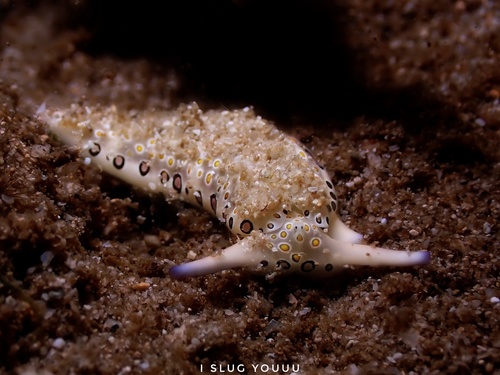
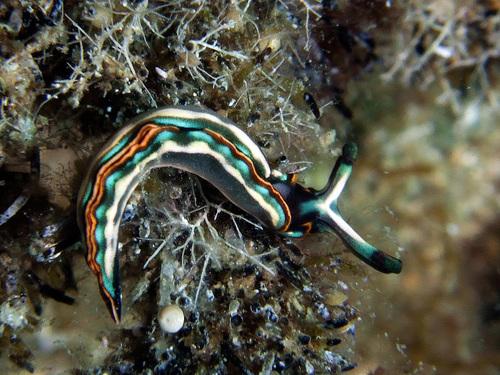
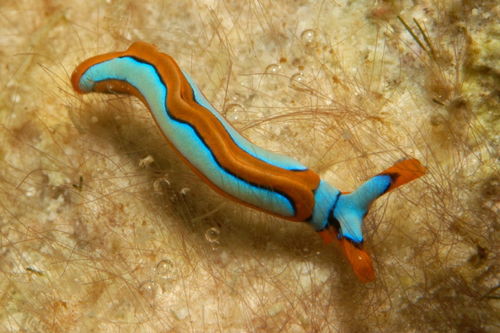
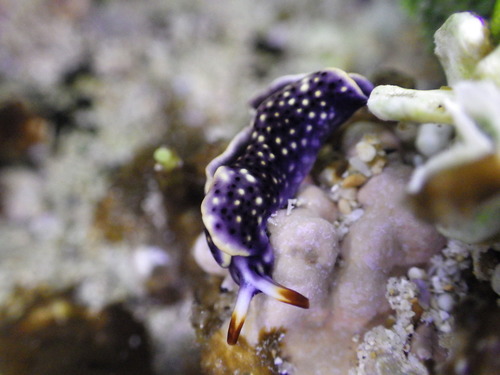
Thuridilla vataae is a small, slender sea slug that reaches a maximum length of about 2 cm (0.8 in). Its purplish head has a large white Y-shaped mark on top that extends forward to a pair of large, coiled rhinophores, which are white with orange-red tips. Long parapodia on either side of the body fold over the back, exposing their undersides. The color of these parapodia varies somewhat, but is usually bluish-violet to dark grey, with raised creamy yellow patches, black circular spots, and a creamy yellow edge. The normally hidden dorsal surface of the body and upper surface of the parapodia are purplish, matching the color of the foot, which is split into two lobes at its anterior end. Thuridilla vataae occurs in the tropical and subtropical Indo-Pacific, with a range stretching from South Africa to Japan, the Philippines, Northern Australia, and Vanuatu. It typically inhabits shallow water reefs and lagoons. This species has a saw-edged radula that it uses to cut and rasp the cell walls of the algae it feeds on. The radula holds 17 to 22 triangular teeth, which are constantly replaced as they wear down. Discarded teeth fall into a mouth cavity where they are stored, and this storage sac expands as it fills with worn teeth over the sea slug's lifespan. Thuridilla vataae is a simultaneous hermaphrodite. When two individuals meet, they pair up and each transfers sperm to the other, with internal fertilization taking place. Each individual later lays a gelatinous string of orange, well-yolked eggs arranged in a concentric spiral. Veliger larvae hatch from the eggs after about five days, and are likely planktonic for a period before settling on the seabed and metamorphosing into juvenile slugs. In terms of coloration, Thuridilla vataae very closely resembles the nudibranchs Hypselodoris infucata and Hypselodoris kanga. These nudibranchs feed on sponges, accumulate toxins from their food, and secrete these toxins from glands on the mantle, which makes them unappetizing to predators. Thuridilla vataae likely gains protection from this resemblance, an example of Batesian mimicry.