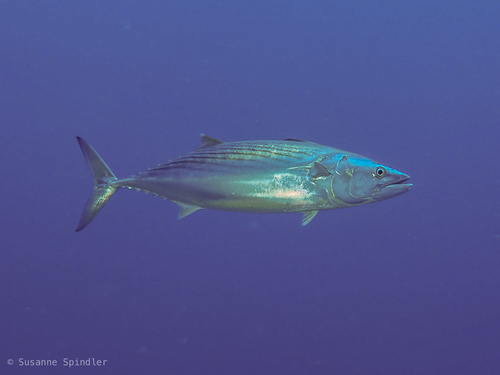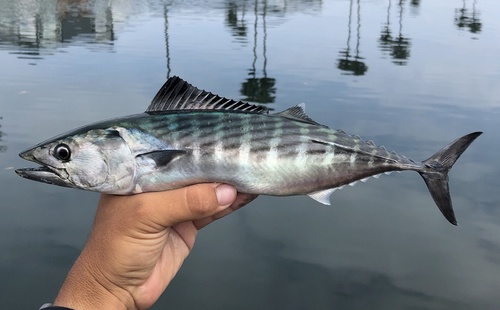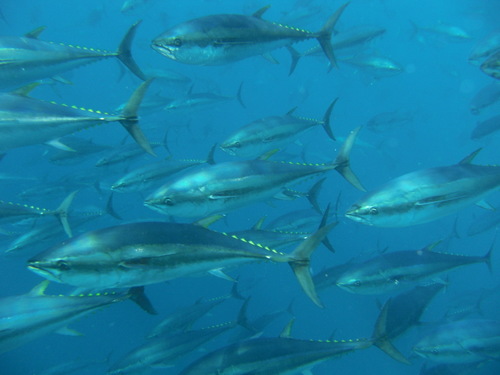
About Thunnus thynnus (Linnaeus, 1758)
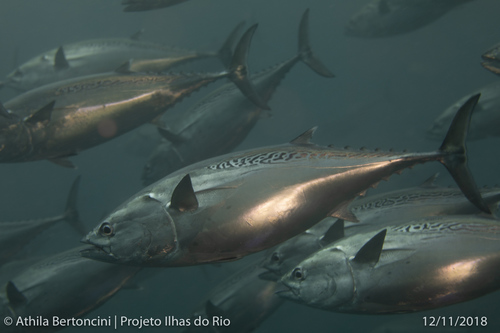
Atlantic bluefin tuna, scientifically Thunnus thynnus (Linnaeus, 1758), has a robust, rhomboidal body shape. It has a conical head, a fairly large mouth, and a unique "pineal window" in the head that helps it navigate during its multi-thousand-mile migrations. Its dorsal side is dark blue, while its ventral side is gray; the entire body has a sparkling golden sheen, and its caudal finlets are bright yellow. Atlantic bluefin tuna can be told apart from other members of the tuna family by its relatively short pectoral fins. A unique trait of this species is that its liver is covered in blood vessels, giving it a striated appearance. In other tunas that also have short pectoral fins, these blood vessels are either entirely absent or only present in small numbers along the liver edges. Fully mature adult Atlantic bluefin tuna average 2–2.5 m (6.6–8.2 ft) in length and weigh around 225–250 kg (496–551 lb). The largest specimen recorded under International Game Fish Association rules was caught off North Lake, Prince Edward Island, an area famous for its huge Atlantic bluefin tuna; this individual measured 3.84 m (12.6 ft) long and weighed 679 kg (1,497 lb). In 1934, near Liverpool, Nova Scotia, the longest recorded fight between humans and a tuna took place: six men taking turns fought a tuna weighing between 164–363 kilograms (361–800 lb) for 62 hours. Both the Smithsonian Institution and the U.S. National Marine Fisheries Service accept that this species can reach up to 910 kg (2,010 lb), though no additional details for this maximum weight are available. Atlantic bluefin tuna reach maturity relatively quickly. In one survey of specimens up to 2.55 m (8.4 ft) long and 247 kg (545 lb) in weight, none were estimated to be older than 15 years. Very large individuals, however, may live as long as 50 years. Atlantic bluefin tuna have enormous muscular strength, which it transmits through a pair of tendons to its lunate-shaped caudal fin for propulsion. Unlike many other fish, it keeps its body rigid while it flicks its tail back and forth, which increases propulsive stroke efficiency. It also has a very efficient circulatory system: it has one of the highest blood hemoglobin concentrations of any fish, allowing it to deliver oxygen to its tissues efficiently, paired with an exceptionally thin blood-water barrier that enables rapid oxygen uptake. To keep its core power-generating muscles for steady swimming warm, Atlantic bluefin tuna uses countercurrent exchange to prevent heat loss to the surrounding water. Heat in venous blood is efficiently transferred to the cool, oxygenated arterial blood that enters a rete mirabile. While all tuna species are warm-blooded, bluefin tuna have a more highly developed thermoregulation ability than any other fish, which allows them to forage for food in the productive but cold waters of the North Atlantic. In terms of biology and ecology, Atlantic bluefin tuna can dive to depths of 1,006 m (3,301 ft). It typically preys on small fish including sardines, herring, mackerel, and eels, as well as invertebrates including squid and crustaceans. It is an opportunistic hunter that forms size-sorted schools for hunting. Its white skeletal muscle supports large contractions that enable burst swimming needed to capture prey. This species hosts over 70 different parasites, though none have been recorded as causing harm to the tuna. One documented parasite of Atlantic bluefin tuna is the tetraphyllidean tapeworm Pelichnibothrium speciosum. Since the definitive host of this tapeworm is the blue shark, which generally does not prey on tuna, Atlantic bluefin tuna is most likely a dead-end host for P. speciosum. Atlantic bluefin tuna is preyed on by a wide range of predators. Newly hatched larvae are eaten by plankton-specialist fish, other planktonic organisms such as jellyfish, and even other Atlantic bluefin tuna, as some larval populations exhibit cannibalism. Larval numbers are drastically reduced by this predation, so adult bluefin tuna spawn at specific locations and at specific times of the moon cycle to reduce predation on their offspring. Individuals that survive to maturity encounter progressively larger predators as they grow. Only the very largest billfishes, toothed whales, and some open ocean shark species prey on adult Atlantic bluefin tuna.