About Thunnus albacares (Bonnaterre, 1788)
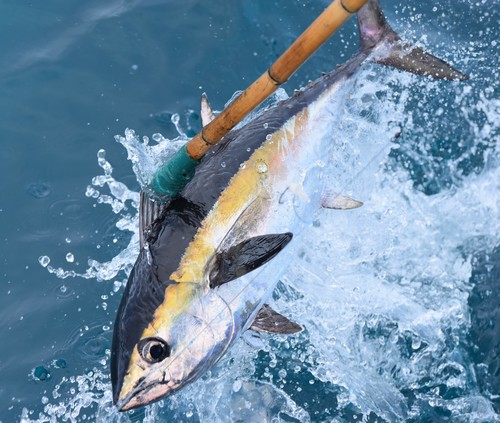
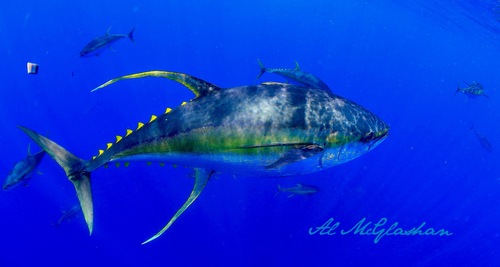
Yellowfin tuna (Thunnus albacares) is one of the larger tuna species, reaching weights over 180 kg (400 lb). It is significantly smaller than Atlantic and Pacific bluefin tunas, which can reach over 450 kg (990 lb), and slightly smaller than bigeye tuna and southern bluefin tuna. This fish gets its common name from its bright yellow second dorsal fin, anal fin, and the small finlets between these fins and the tail. In mature individuals, the second dorsal and anal fins can grow very long, reaching almost to the tail and appearing shaped like sickles or scimitars. Its pectoral fins are longer than those of related bluefin tuna, but shorter than the pectoral fins of albacore tuna. The main body of the yellowfin tuna is a very dark metallic blue, fading to silver on the belly, which has around 20 vertical lines. Published reports note this species can reach a maximum length of 2.4 m (7 ft 10 in) and a maximum weight of 200 kg (440 lb). The all-tackle International Game Fish Association (IGFA) record for the species is 193.68 kg (426 lb 15+3⁄4 oz), set by a yellowfin caught in 2012 off Cabo San Lucas, Mexico. The fisherman was awarded a $1 million prize after the catch was confirmed by the IGFA. Yellowfin tuna are epipelagic fish that live in the mixed surface layer of the ocean above the thermocline. Sonic tracking studies show that unlike related bigeye tuna, yellowfin tuna mostly stay in the top 100 m (330 ft) of the water column. One study found their depth range changes with the time of day: 90% of recorded depth readings were less than 88 m (289 ft) deep at night, and less than 190 m (620 ft) deep during the day. While yellowfin tuna only cross the thermocline relatively rarely, they are able to dive to considerable depths. One individual tagged with an archival tag in the Indian Ocean spent 85% of its time in depths shallower than 75 m (246 ft), but was recorded making three dives to 578 m (1,896 ft), 982 m (3,222 ft), and 1,160 m (3,810 ft). The maximum dive depth recorded in a separate study was 1,592 m (5,223 ft).