About Thunnus alalunga (Bonnaterre, 1788)
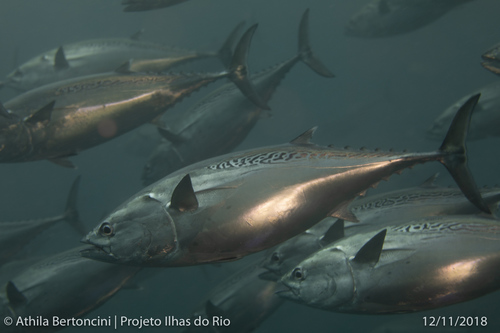
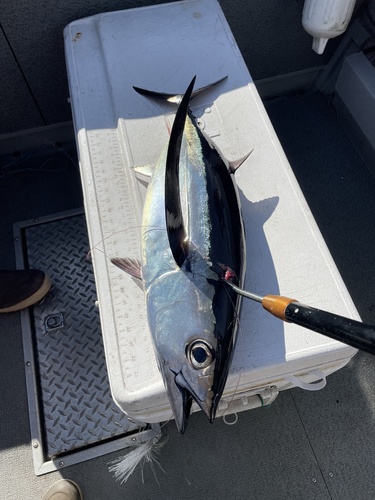
Albacore, scientifically named Thunnus alalunga (Bonnaterre, 1788), has a streamlined fusiform body with a conical snout, large mouth, and large eyes. Its dorsal body is dark blue, its ventral body is shaded silvery white, and its entire body is covered in small scales. The pectoral fins start slightly ahead of the first dorsal fin and extend well past the front of the anal fin, usually reaching as far as the second dorsal finlet. They often make up 30% of the fish's total total length. The upper sides of the fins match the dark blue color of the fish's dorsal body, while the underside of the fins is medium yellow. Pectoral fins are noticeably shorter in albacore shorter than 0.5 m (1 ft 8 in) in total length, which often leads to confusion with juvenile T. obesus. Juvenile T. obesus also have long pectoral fins, but their fin tips are rounded, while albacore pectoral fins taper to a point. The first dorsal fin is deep yellow; the second dorsal fin is smaller than the first and is light yellow, the same color as the anal fin. Albacore have 7 to 9 dorsal finlets and 7 to 8 anal finlets. Dorsal finlets are dark blue to match the fish's dorsal body, while anal finlets are silvery white to match the fish's ventral body. The caudal fin is also silvery white. At a maximum length of 1.4 m (4 ft 7 in), albacore are the smallest of the bluefin tuna. They reach sexual maturity at 0.9 m (2 ft 11 in), and their common average length is only slightly larger at 1.0 m (3 ft 3 in). Males and females show no sexual dimorphism. Albacore have a cosmopolitan distribution across tropical and temperate waters of every global ocean, as well as the Mediterranean Sea. Their latitudinal range extends from 59°N to 46°S. They occupy a temperature range of 10–25 °C (50–77 °F) and a depth range of 0–600 m (0–1,969 ft; 0–328 fathoms), found in both the epipelagic and mesopelagic zones. They are most often found in surface waters with temperatures between 15.6–19.4 °C (60.1–66.9 °F), though larger individuals can be found in deeper waters with temperatures between 13.5–25.2 °C (56.3–77.4 °F). They can survive at temperatures as low as 9.5 °C (49.1 °F) for short periods, and prefer areas where warm and cool water mix. Albacore are powerful, hard-hitting predators. They form mixed schools with skipjack tuna, yellowfin tuna, and bluefin tuna, sometimes gathering around floating objects such as sargassum weeds. Albacore schools are highly migratory within water bodies and are segregated by maturity, with older fish tending to form more compact groups. Among albacore caught by humans, immature individuals have a 1:1 sex ratio, while older individuals are mostly male. In the Atlantic Ocean, older albacore are found in cooler waters. The opposite pattern holds in the Pacific Ocean, where albacore are more abundant along thermal discontinuities. Depth range also varies by location: Atlantic albacore can dive as deep as 600 m (2,000 ft), while Pacific albacore only reach depths of 380 m (1,250 ft). In the northeast Atlantic, albacore make feeding migrations to productive areas during the summer. Over the last 40 years, climate change has altered both the timing and spatial distribution of albacore. Albacore also have a wide range of behavioral differences across regions. Off Baja California, albacore make frequent dives to depths over 200 m (660 ft) during the day and stay near the surface at night, while off the coasts of Washington and Oregon they stay near the surface throughout the entire day. Albacore never truly rest; their oxygen requirement means they must constantly be moving.