About Thuja plicata Donn ex D.Don
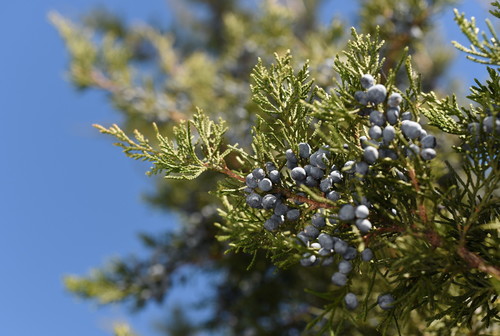
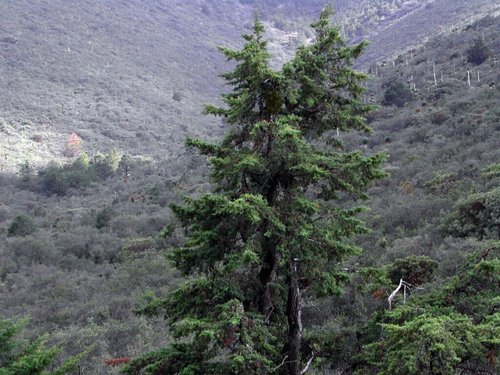
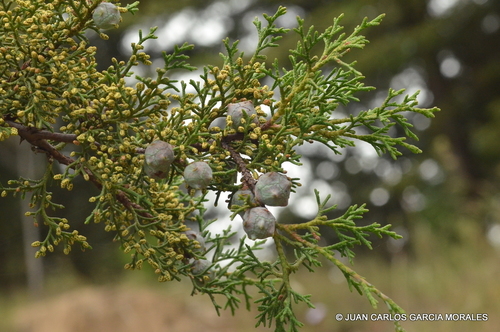
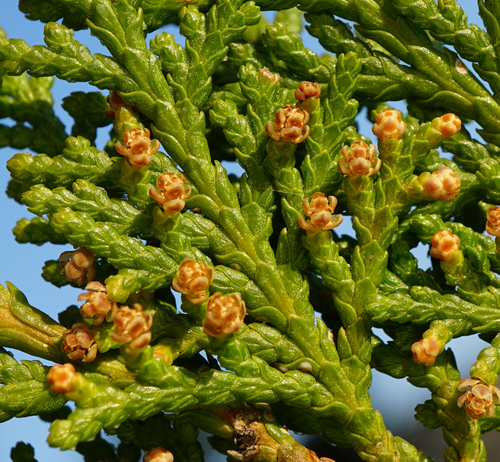
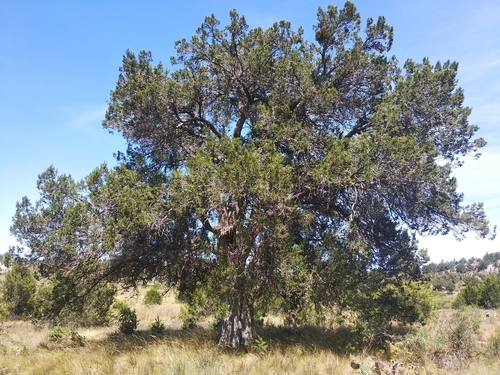
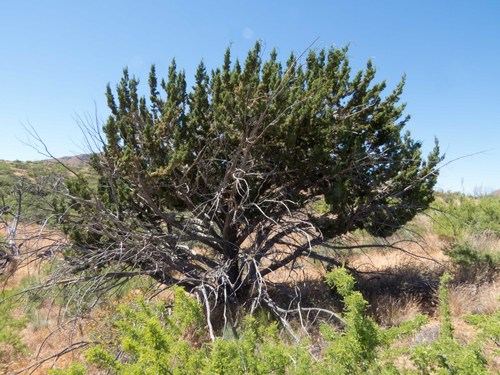
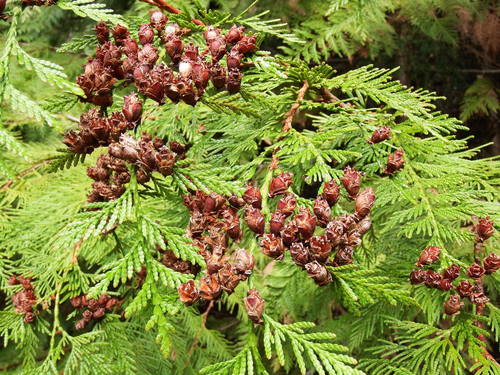
Thuja plicata Donn ex D.Don is a large to very large tree, reaching 45 to 70 metres (150 to 230 feet) in height and 2.4 to 7 metres (8 to 23 feet) in trunk diameter, making it larger than any other species in its genus. Its trunk swells at the base, and it has shallow roots. The bark is thin, gray-brown, and split into vertical fissured bands. Open-grown trees may have a crown that extends all the way to the ground, while densely spaced trees only develop a crown at the top where leaves can access light. As the tree ages, wind damages the original top, which is then replaced by smaller, less vigorous branches. Thuja plicata is long-lived; some individuals live well over a thousand years, with the oldest verified individual dated to 1,460 years old. Its foliage grows in flat sprays, made up of scale-like leaves arranged in opposite pairs, with each successive pair oriented at 90 degrees to the previous pair. Foliage sprays are solid green, with whitish stomatal bands on their lower surface; when crushed, they give off a strong aroma similar to pineapple. Individual leaves measure 1 to 4 millimetres (1⁄32 to 5⁄32 inch) long and 1 to 2 mm (1⁄32 to 3⁄32 inch) broad on most foliage sprays, but can reach up to 12 mm (1⁄2 inch) long on strong-growing lead shoots. Foliage on individual branchlets turns orange-brown before falling off in autumn. Branches growing in full sun produce denser foliage with more overlap, while shaded branches grow more horizontally with less overlap. Its cones are slender, 10 to 18 mm (3⁄8 to 11⁄16 inch) long and 4 to 5 mm (5⁄32 to 3⁄16 inch) broad, with 8 to 12 (rarely 14) thin, overlapping scales. Cones are green to yellow-green when young, ripening to brown in autumn approximately six months after pollination, and open at maturity to release seeds. The seeds are 4 to 5 mm (5⁄32 to 3⁄16 inch) long and 1 mm (1⁄32 inch) broad, with a narrow papery wing running down each side. Pollen cones are 3 to 4 mm (1⁄8 to 5⁄32 inch) long, initially red or purple, and shed yellow pollen in spring.
Thuja plicata is among the most widespread trees in the Pacific Northwest. In most of its growing range, it is found growing alongside Douglas-fir (Pseudotsuga menziesii) and western hemlock (Tsuga heterophylla). It grows best on moist sites in regions with a wet maritime climate, and only occurs in areas with annual precipitation exceeding 71 centimetres (28 inches). Its native range extends from the Cascade Range and Coast Mountains westward to the Pacific Ocean, running from central Southeast Alaska (near the village of Kake) to northern California; at the northern and southern ends of its range, it grows closer to the coast. A separate isolated (disjunct) population occurs inland from central-southeast British Columbia through the Idaho Panhandle. The easternmost edge of its native range is in Glacier National Park, Montana, where it is a major component of forests surrounding Lake McDonald. A small number of small, isolated stands of the species grow east of the continental divide in the park. It is typically found from sea level up to 1,100 m (3,600 ft) in elevation, but grows as high as 2,290 m (7,510 ft) at Crater Lake, Oregon and 1,500 m (4,900 ft) in Idaho. Western redcedar grows across many soil types. It occurs across all landforms and soil classes on Vancouver Island, but is restricted to wet, low-lying areas and streamsides in the drier eastern portions of its range. Unlike its common associates western hemlock and Douglas-fir, western redcedar can grow successfully in environments with stagnant groundwater less than 5 centimetres (2 inches) below the soil surface during winter. It does not grow as well in areas with flowing groundwater, which differs from another common associate, Sitka spruce (Picea sitchensis). In the Rocky Mountains and along the eastern slope of the Washington Cascades, western redcedars growing on glacial till and sedimentary rocks have higher mortality rates than those growing on other substrates. By contrast, western white pine (Pinus monticola) and Douglas-fir growing in these areas have low mortality on glacial till and sedimentary rocks, but high mortality on nutrient-poor metasedimentary rocks — a substrate that does not cause elevated mortality for western redcedar. Western redcedar is less cold-tolerant than many conifer species that share its range, and is vulnerable to frost damage in late spring and early fall. Its northern range limit in Southeast Alaska and its upper elevation limit on Vancouver Island are controlled by temperature. In Southeast Alaska, it does not occur in areas with mean summer temperatures lower than 11 °C (52 °F). It also does not grow in areas of coastal British Columbia with minimum temperatures below −30 °C (−22 °F), though some interior populations experience colder temperatures. The species has been introduced to other temperate zones, including areas further north in Alaska, western Europe, Australia (reaching at least as far north as Sydney), New Zealand, and higher elevations of Hawaii. A 2004 survey identified the species as invasive in Great Britain, but as of September 2022, the United Kingdom Department for Environment, Food and Rural Affairs has not listed it as invasive under the Wildlife and Countryside Act 1981. It has also been recorded in Poland, where it has been identified as a potentially problematic exotic species in Białowieża Forest.
Thuja plicata is considered to have low to moderate fire resistance, because its thin bark, shallow roots, low dense branching habit and flammable foliage provide little protection against fire. Small trees are commonly killed by fire, but larger specimens often survive due to their size if they are not completely girdled. Fire intervals in western redcedar stands tend to be very long, ranging from 50 to 350 years or more.
Western redcedar provides cover for bears, raccoons, skunks, and other animals that nest inside trunk cavities. It serves as a nest tree for cavity-nesting bird species including yellow-bellied sapsuckers, hairy woodpeckers, tree swallows, chestnut-backed chickadees, and Vaux's swifts. Pileated woodpeckers on the Olympic Peninsula prefer very large western redcedars affected by heart rot when choosing roosting sites, but do not nest in these trees, instead relying on Pacific silver fir (Abies amabilis) for nesting. Old-growth valley bottom forests of western redcedar and western hemlock are the preferred habitat for white-tailed deer in the Priest River drainage of northern Idaho, because the dense canopies limit deep snow accumulation that makes movement difficult for deer. The foliage, especially that of saplings, is an important year-round food source for browsing ungulates such as Roosevelt elk and black-tailed deer, and is particularly important during winter when few other food sources are available. Western redcedar foliage is more palatable to browsing herbivores than the foliage of its common associates Sitka spruce and western hemlock. Browsing by introduced Sitka black-tailed deer is a major cause of mortality for seedlings and saplings in old-growth forests on Haida Gwaii, where the deer have no natural predators. The presence of deer in this area has been linked to reduced western redcedar recruitment. Seeds of the species may be eaten by birds and rodents such as deer mice, but they are apparently not a preferred food source for most species, possibly due to their small size or unpleasant odor. A 1937 study conducted in western Cowlitz County, Washington found that deer mice strongly prefer Douglas-fir and western hemlock seeds over western redcedar seeds. However, pine siskins appear to favor western redcedar seeds over those of Douglas-fir and western hemlock.
Like its relative Thuja occidentalis and many other conifer species, T. plicata is cultivated as an ornamental tree, and for screens and hedges, in gardens and parks around the world. A wide variety of cultivars with different forms, sizes, and foliage colors are available. The following cultivars have received the Royal Horticultural Society's Award of Garden Merit: 'Atrovirens', 'Aurea', 'Stoneham Gold', 'Whipcord', 'Zebrina'. Beyond ornamental cultivation, T. plicata is also widely used across Europe and America to make beehive components. Its bark has been studied for applications in polyurethane. Joinery-grade timber of the species is used to construct windows and doors. Western redcedar is still highly valued as "tonewood" for the sound boards of stringed instruments.