About Thryorchilus browni (Bangs, 1902)
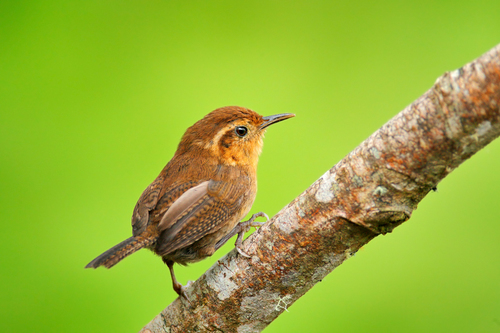
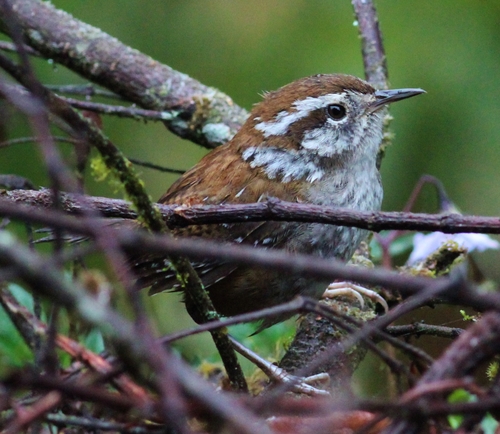
The timberline wren (Thryorchilus browni (Bangs, 1902)) measures 10 cm (3.9 in) long and weighs 14 g (0.49 oz). Adult birds of the nominate subspecies have rich chestnut brown crowns and upperparts, and a reddish brown tail marked with thin dark bars. They have a broad gray-white supercilium, a chocolate brown stripe behind the eye, and grayish cheeks with narrow black markings. Their throat and chest are grayish white, their upper belly is mottled grayish white, their lower belly is brown, and their flanks and vent area are reddish brown. Juvenile timberline wrens are grayer on their underparts, which have a scalloped appearance. The subspecies T. b. ridgwayi is larger than the nominate subspecies and has deeper reddish brown upperparts. The subspecies T. b. basultoi has a wider supercilium, whitish markings on its upperparts and the sides of its neck, and whiter underparts.
The timberline wren has a disjunct range that extends from central Costa Rica south to northern Panama. The subspecies T. b. ridgwayi occurs on Volcán Turrialba, Volcán Irazú, and adjacent areas in central Costa Rica. T. b. basultoi is found in the Cordillera de Dota of south central Costa Rica. The nominate T. b. browni lives on Volcán Barú, Volcán de Chiriquí, and Cerro Copete in western Panama. This wren species inhabits páramo and near-páramo moorland at the upper edge of the tree line, and it prefers bamboo thickets. Most individuals are found at elevations between 2,800 and 3,600 m (9,200 and 11,800 ft), though some can be found as low as 2,200 m (7,200 ft).