About Thryophilus pleurostictus (P.L.Sclater, 1860)
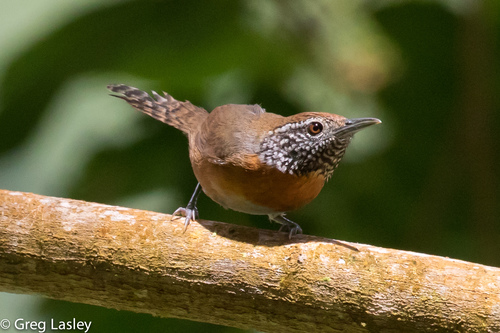
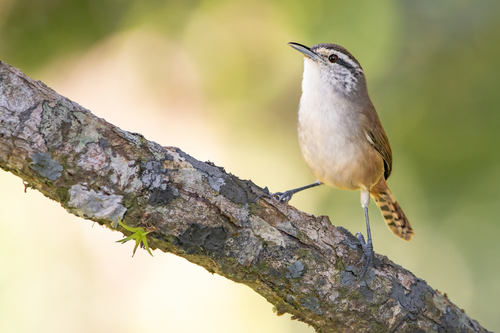
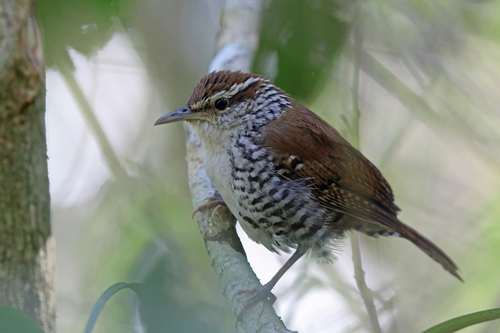
The banded wren, Thryophilus pleurostictus, is a small songbird in the wren family. It is a non-migratory breeding species found from central Mexico to Costa Rica. Prior to 2006, this species was classified in the genus Thryothorus, per research by Mann et al. (2006). Banded wrens breed in lowlands and foothills, from sea level up to 800 m altitude, in open or scrubby woodland including forest clearings and second-growth areas. They are found mainly on the Pacific side of the region's central mountain ranges. The species builds a flask-shaped nest lined with fine grasses, which has a long entrance tube angled downward. Nests are constructed 1 to 2.5 meters high in the fork of a thorny tree or shrub, and are often placed close to a wasp nest. Only the female incubates the three or four unspotted white or pale greenish-blue eggs; incubation takes around two weeks until hatching, and young birds fledge after another approximately two-week period. Adult banded wrens measure 13.5 cm in length and weigh 20 g. Adults have chestnut brown upperparts, prominent white supercilia, a brown stripe running through the eye, and black streaking on their white cheeks. Their underparts are white, with heavy black barring on the lower belly and flanks. The wings and tail are also barred with black. Young birds have duller upperparts than adults, and dull white underparts faintly mottled with dusky brown. The species' call is a nasal cherrrt, or a rattle-and-roll sequence kert rrruk kert rrruk, while its melodious, complex song is a mix of clear whistles and musical trills. Banded wrens forage actively in low vegetation, or sometimes on the ground, moving in pairs or family groups. Their diet consists mainly of insects, spiders, and other invertebrates.