About Thryomanes bewickii (Audubon, 1827)
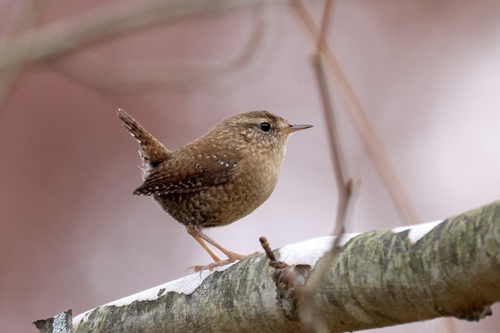
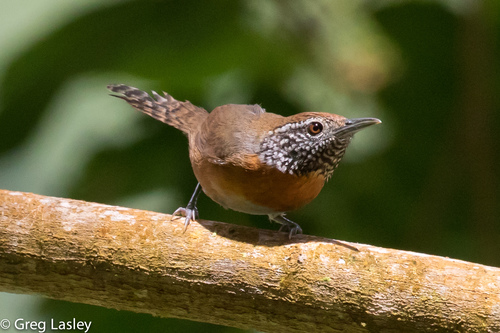
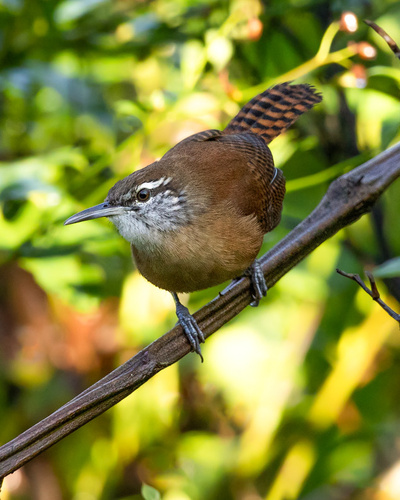
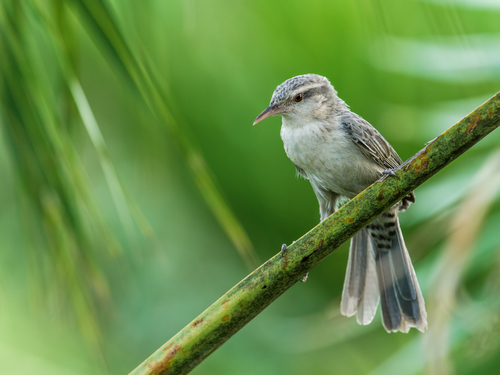
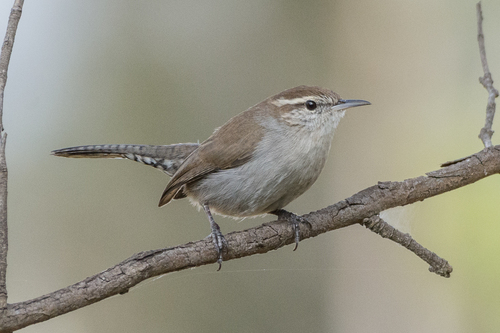
Bewick's wren, with the scientific name Thryomanes bewickii (Audubon, 1827), has an average length of 5.1 inches (13 cm), an average weight of 0.3 to 0.4 ounces (8–12 g), and a wingspan of 18 cm. Its upper plumage is brown, and its underparts are light grey, with a white stripe above each eye. The beak is long, slender, and slightly curved. Its most distinctive feature is its long tail, which has black bars and white corners. This wren moves its tail frequently, making this prominent feature even more noticeable to observers. Juveniles look similar to adults, with only a few key differences: their beaks are usually shorter and stockier, and their underbelly may have faint speckling. Males and females are very similar in appearance. Geographic variation has been observed in Bewick's wren appearance. Before their population decline, eastern populations were described as more colorful, with a reddish tint to their brown feathers. Pacific populations are darker in appearance, while Southwestern populations have grayer plumage. Geographic differences are also noted in Bewick's wren songs. Each regional population has distinctive vocalizations, particularly in its call notes. Pacific populations sing notably more complicated songs than Southwestern populations. Eastern populations, before their decline, were also recorded as excellent singers. Bewick's wren once ranged across much of the United States and Mexico, as well as parts of Canada. It was once fairly common in the Midwest and Appalachian Mountains, but it is now extremely rare east of the Mississippi River. It can still be found along the Pacific Coast from Baja California to British Columbia, throughout Mexico, and across a large portion of the Southwest including Texas, Arizona, New Mexico, and Oklahoma. Western populations generally do not migrate. Before their decline, eastern populations migrated from their northern range to the Gulf Coast. The preferred habitat of Bewick's wren is arid open woodlands and brush-filled areas such as hillsides and uplands, but it will also live in local humid areas within Subtropical and Temperate zones. It is more common than house wrens in drier habitats like those found in the Southwest. In California, Bewick's wrens live in the shrubland habitat known as chaparral.