About Threskiornis molucca (Cuvier, 1829)
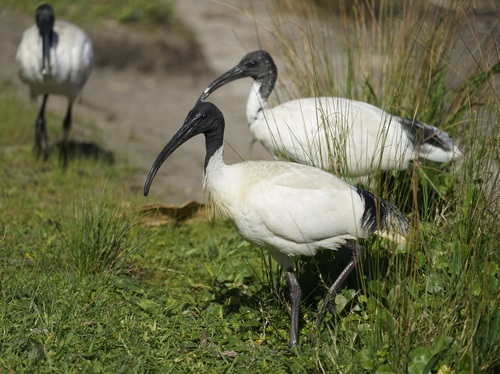
This species, the Australian white ibis, is a fairly large ibis. It measures around 65–75 cm (26–30 in) in total length, and has a completely bald black head and neck, plus a long black downcurved beak. Males have a beak longer than 16.7 cm (6.6 in), while females have a beak shorter than this measurement. The species shows sexual dimorphism in size: males are slightly heavier, weighing between 1.7–2.5 kg (3.7–5.5 lb), while females weigh 1.4–1.9 kg (3.1–4.2 lb). For comparison, the American white ibis usually reaches a weight of just 1 kg (2.2 lb). The bird's body plumage is white, though it can become stained brown. Inner secondary plumes are displayed as lacy black feathers that look like a tail. The upper tail turns yellow during the breeding season. The legs and feet are dark, and red skin is visible on the underside of the wing. Immature birds have shorter bills, and juvenile birds have feathers covering their head and neck. The Australian white ibis's call is a long croak. It reaches sexual maturity at three years of age, and can live up to 28 years old. The Australian white ibis is widespread across eastern, northern, and south-western Australia. It lives in marshy wetlands, often near open grasslands, and has become common in city parks and rubbish dumps across urban areas of the Australian east coast, including Wollongong, Sydney, Perth, the Gold Coast, Brisbane, and Townsville. Historically, the species was rare in urban areas. The first records of birds visiting urban areas came after drought pushed populations eastwards in the late 1970s, and there were no recorded breeding events in Sydney until the 1980s. The Macquarie Marshes in north-western New South Wales was once one of this ibis's main breeding areas, with 11,000 nests recorded there in 1998. However, no breeding events have been recorded at this site since 2000. The species does not occur in Tasmania. Populations of the Australian white ibis, especially in urban areas, have boomed multiple times: in the 1970s, the early 2000s, and around 2010. There is no national monitoring program for the species, so there are no official total population counts.