About Threskiornis aethiopicus (Latham, 1790)
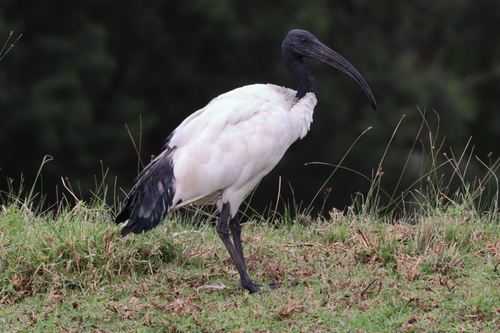
Adult African sacred ibises (Threskiornis aethiopicus) measure 68 cm (27 in) in overall length, with all-white body plumage except for dark plumes on the rump. Their wingspan ranges from 112 to 124 cm (44 to 49 in), and their body weight falls between 1.35 and 1.5 kg (3.0 to 3.3 lb). Males are typically slightly larger than females. Their head and neck are bald, and their thick curved bill and legs are all black. When in flight, their white wings display a black border along the rear edge. Their eyes are brown, with a dark red orbital ring. Male and female adults have similar plumage, but juveniles have dirty white plumage, a smaller bill, partial feathering on the neck, greenish-brown scapulars, and more black on the primary coverts. This species is usually silent, but will occasionally make puppy-like yelping noises, which differs from its vocal relative, the hadada ibis.
The African sacred ibis lives in marshy wetlands and mud flats, found both inland and along the coast. It prefers to nest on trees that stand in or near water. It feeds while wading in very shallow wetlands, or by slowly stomping through wet pastures with soft soil. It will also visit areas of cultivation and rubbish dumps to feed.
This species usually breeds once per year, during the wet season. Its breeding season runs from March to August across Africa, and from April to May in Iraq. It builds a stick nest, most often in a baobab tree. The ibis nests in tree colonies, frequently alongside other large wading bird species including storks, herons, African spoonbills, African darters, and cormorants. It may also form single-species nesting groups on offshore islands or abandoned buildings. Nests on islands are often built directly on the ground. Large colonies are made up of multiple subcolonies and can hold up to 1000 individual birds. Females lay between one and five eggs each breeding season, and both parents share incubation duty over a period of 21 to 29 days. After hatching, one parent remains at the nest continuously for the first seven days. Chicks fledge between 35 and 40 days after hatching, become independent between 44 and 48 days, and reach sexual maturity between one and five years after hatching.