About Thordisa bimaculata Lance, 1966
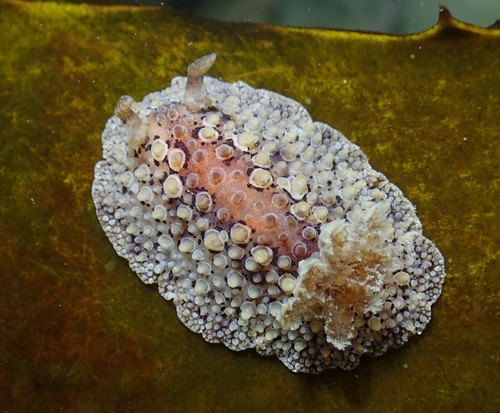
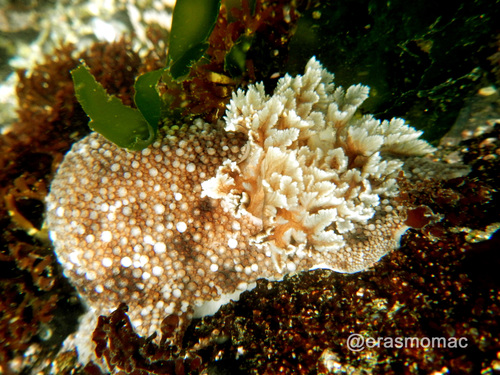
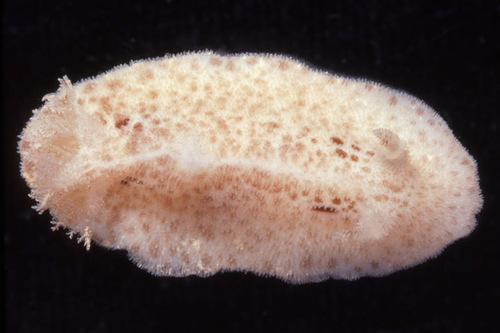
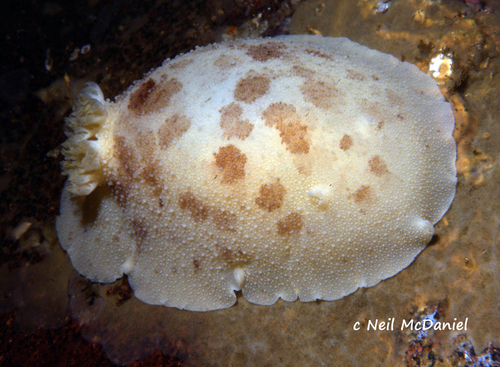
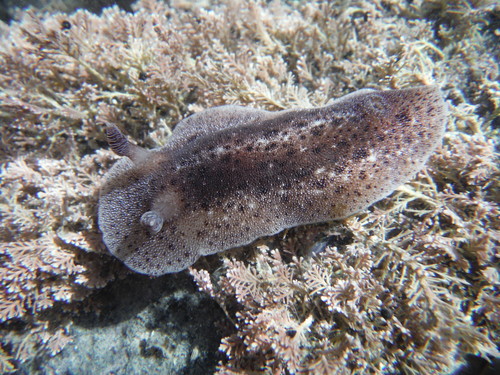
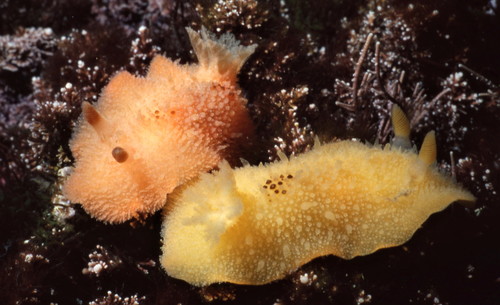
This species is commonly called the two-spotted dorid, with the scientific name Thordisa bimaculata Lance, 1966. The base body color of the two-spotted dorid ranges from white, pale yellow, to orange. Both its common name and scientific name reference two small clusters of dark brown spots on its mantle: one spot cluster sits behind the rhinophores, and the other sits in front of the gills. In different individuals, these spotted patches can be relatively pale or indistinct, especially when covered by sand grains or other small debris. The mantle of the two-spotted dorid is covered in long, bulbous papillae that taper toward their ends. Researchers have found that the dorsal papillae of another species in the same genus, Thordisa verrucosa, excrete an adhesive substance that holds debris in place, likely for camouflage. It is probable that the dorsal papillae of the two-spotted dorid perform this same function. Adult two-spotted dorids typically reach a length of 28 mm (1.1 in). In terms of body shape, this species resembles other dorid nudibranchs: it has an overall rounded body, a squat pointed posterior end, and retractable gills. The foot of the two-spotted dorid is roughly two-thirds the width of its full body. Near its mouth, this nudibranch has two slender, finger-like tentacles. The two-spotted dorid occurs in the eastern Pacific Ocean along the coasts of California and Baja California. While northward shifts in its range have been linked to warm ocean anomaly events, most observations of the species are concentrated in the Southern California Bight. It lives in the rocky intertidal zone, and can be found at depths up to 33 m. Like many other nudibranchs, the two-spotted dorid is spotted more often during the summer. Like all nudibranchs, the two-spotted dorid is a simultaneous hermaphrodite. When mating, individuals wrestle to establish dominance, each attempting to penetrate and inseminate the other with its penis. The penis of the two-spotted dorid is armored with 7 to 10 thick, hooked spines that help with this mating process. The species' eggs, called nidosomes, are yellow in color. Like eggs of other sea slugs, they are laid in coiled ribbons and attached to rocky substrates.