About Thorax porcellana (Saussure, 1862)
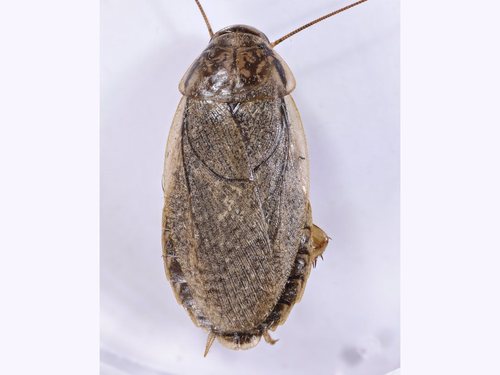
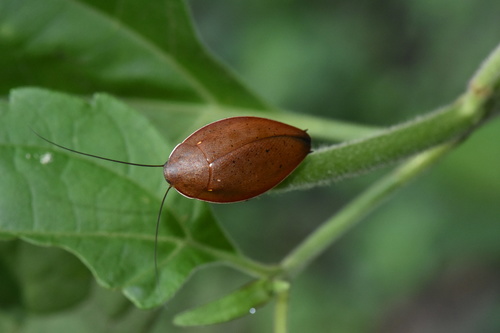
Thorax porcellana (Saussure, 1862) is a species of epilamprid cockroach found in Sri Lanka and India. Both sexes have fully developed wings, but only males are capable of flight, and even males fly rarely and only for short distances. In 1981, Louis M. Roth hypothesized that the arched tegmina seen in the genera Phoraspis and Thorax were similar to those of Phlebonotus pallens, which suggested these species might share similar maternal care behaviors. In 1998, Indian entomologist S. Bhoopathy confirmed that this ovoviviparous species carries 30 to 40 newly hatched nymphs through their first two instars in a specialized recess located under the mother's domed forewings on her dorsal surface. The nymphs stay in this recess for approximately 7 weeks, during which they drink a pinkish liquid secreted between the tergites of the mother's abdomen. They also use their relatively long, sharp, mandibular tooth-like processes to pierce the mother's cuticle and feed directly on her haemolymph. These specialized 'teeth' are shed after the nymphs complete their first two instars, when they no longer have a close association with their mother. Bhoopathy described the behavior as: "Immediately after hatching, the first instar nymphs crawled over the abdomen of the mother. The upper surface of her abdomen became markedly depressed into a fairly tight spacious trough or chamber with its sides raised. As the nymphs crawled over her body, she raised up her tegmina, which were large, tough, and dome-shaped, and all the nymphs were accommodated compactly; the tegmina were placed in position so as to conceal all the nymphs and to afford perfect protection." Parental care where offspring feed on parental bodily secretions is not uncommon among cockroaches, and this behavior has already been recorded in the genera Perisphaerus, Trichoblatta, Pseudophoraspis, Phlebonotus, Gromphadorhina, Solganea, Cryptocercus and Blattella. By contrast, biparental care only occurs in wood-eating cockroaches, as wood is low in nutrients and becomes assimilable only with the help of micro-organisms that live in the adult gut.