About Thor amboinensis (De Man, 1888)
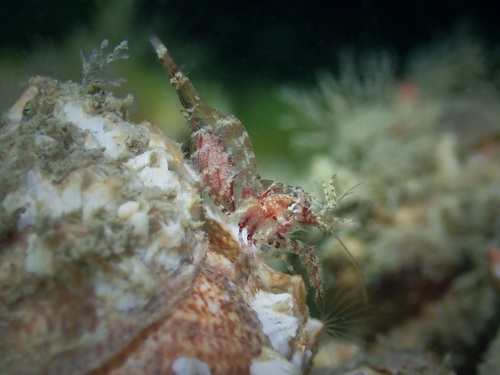
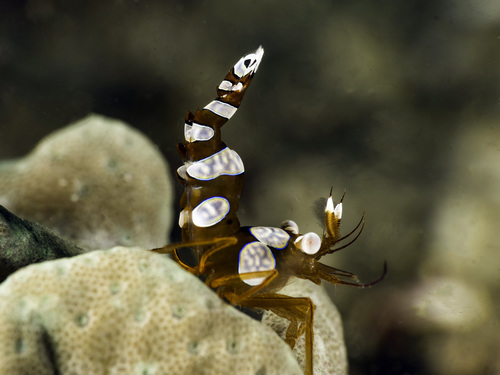
Thor amboinensis is a small shrimp that grows to a length of approximately 13 millimetres, or 0.5 inches. It has an olive brown body marked with symmetrically placed white patches, which are outlined by thin blue lines. A key characteristic of this species is that it holds its abdomen curved upwards, with its tail fan positioned above its head. Although the species is named after Ambon (also called Amboyna) Island, one of Indonesia's Maluku Islands, Thor amboinensis has a pantropical distribution. It can be found in the Red Sea, the Indian Ocean, the Pacific Ocean, the Caribbean Sea, the Gulf of Mexico, Madeira and the Canary Islands. Thor amboinensis forms a commensal relationship with another invertebrate, most commonly a shallow water sea anemone or mushroom coral. In Bermuda, the most frequent host species are the carpet anemone (Stichodactyla haddoni), the stinging anemone (Lebrunia danae) and the adhesive anemone (Cryptodendrum adhaesivum). Either one or multiple shrimp live among their host's tentacles, feeding on tentacle tissue and planktonic particles trapped in the host's mucus that adhere to the tentacles. In the Bahamas, Thor amboinensis is part of a group of symbiotic invertebrates that associate with the anemone Lebrunia danae. Each type of shrimp, crab and brittle star that lives on the sea anemone occupies its own distinct section, and Thor amboinensis is found hidden deep among the anemone's pseudotentacles. Female Thor amboinensis carry fertilised eggs under their abdomen until the eggs are ready to hatch. The zoea larvae go through several developmental stages, and before undergoing metamorphosis, they respond to both chemical cues in the water and visual cues that lead them to settle near potential host anemones. Research has found that Thor amboinensis larvae are generalists, attracted to and willing to accept several different anemone species as hosts. In experiments, the larvae often showed a preference for the same anemone species that their parent shrimp were collected from.