About Thopha saccata (Fabricius, 1803)
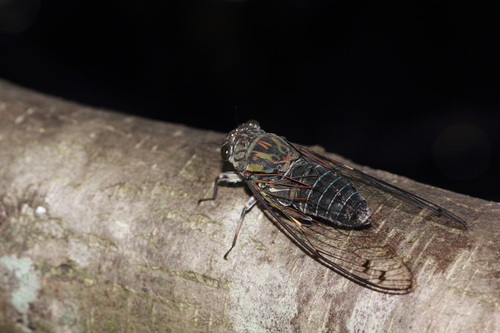
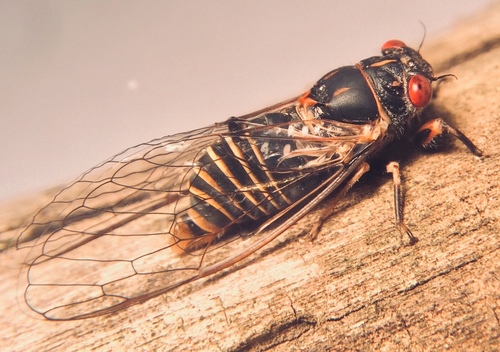
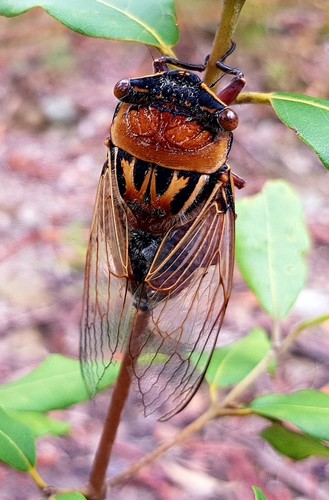
This species has the scientific name Thopha saccata (Fabricius, 1803), commonly called the double drummer. Adult double drummers are the largest cicada species native to Australia. Males average 4.75 cm (1.87 in) in length, while females average 5.12 cm (2.02 in). Their thorax measures 2 cm (0.79 in) in diameter, with sides more distended than those of other Australian cicadas. Forewings range from 5 to 6.6 cm (2.0–2.6 in) in length. The average wingspan is 13.3 cm (5.2 in), and the largest recorded collected specimen has a wingspan of 15.1 cm (5.9 in). The average adult mass is 4.0 g (0.14 oz). The sexes share similar markings, but males have large dark red-brown sac-like structures on each side of their abdomens that cover the tymbals — specialized structures made of vertical ribs and a tymbal plate, which buckles to produce the cicada’s song. The head is much broader than that of other cicadas, and broader than the pronotum behind it. The head, antennae, and postclypeus are black, with a narrow broken pale brown transverse band across the vertex just behind the ocelli. The eyes are black when the adult first emerges, then turn brown with black pseudopupils at the posterior edge of the eye. The ocelli are deep red. The proboscis is 1.26 cm (0.50 in) long, which is very long compared to other Australian cicada species. The thorax is brown, and becomes paler as individuals age. The pronotum is rusty brown with black anterior borders; the mesonotum is slightly paler with prominent black markings, featuring paired cone-shaped spots with bases facing forward on either side of a median stripe. Lateral to these spots is a pair of markings that resemble a "7" on the right side of the mesonotum and the mirror image of a 7 on the left. The abdomen is black between the tymbal covers, and a mix of red-brown and black further toward the rear. The underparts are red-brown and black, and covered in fine silvery velvety hairs. The female’s ovipositor is very long, measuring 1.76 cm (0.69 in). The wings are transparent (vitreous) with light brown veins. The legs are dark brown and covered in grey velvety hairs. There is little color variation across the species’ range, though occasional females are darker overall than average, with less prominent or completely absent markings. The double drummer is larger and darker overall than the closely related northern double drummer (T. sessiliba); the northern double drummer has a white band on the abdomen, while the double drummer has black markings on the leading edge (costa) of the forewing that extend past the basal cell. Male double drummers produce loud calls to attract females, which have been described as "the sound of summer". The double drummer’s song is reportedly the loudest produced by any insect, and can reach an earsplitting volume over 120 dB when large numbers of cicadas are calling at close range. The song is monotonous and dronelike, and has been compared to high-pitched bagpipes. The sound produced by buckling the tymbal plate resonates in an adjacent hollow abdominal chamber, as well as in the exterior air-filled sacs that act as Helmholtz resonators. Singing can stop and restart suddenly, at either rare or frequent intervals, and often ends abruptly. The song has been transcribed as "Tar-ran-tar-rar-tar-ran-tar-rar", and consists of a series of pulses emitted at a rate of 240 to 250 pulses per second. The tymbal covers are much larger than those of other cicada species, which makes the call louder and directs it in a specific direction. There are two distinct song phases, and the double drummer switches between them at irregular intervals. One phase is a continuous call that can last for several minutes; during this phase, the frequency varies between 5.5–6.2 kHz and 6.0–7.5 kHz four to six times per second. In the other phase, the song is interrupted by breaks of increasing frequency, creating a staccato sound. Because the volume difference between the main song and quieter periods is so large, these breaks can be mistaken for silence, even though the song actually continues at a much lower volume. This staccato phase lasts for several seconds, and the frequency holds steady around 5.75–6.5 kHz. The song frequency is a high harmonic of the pulse repetition frequency, which produces a particularly ringing sound. Double drummers congregate in groups to amplify their calls, which likely repels potential bird predators. Male double drummers also produce a sharp, fragmented irregular distress call when seized by a predator. The double drummer has a disjunct distribution in eastern Australia: it occurs from northern tropical Queensland, near Shiptons Flat and Cooktown, south to Ingham and Sarina, and then from Gympie in southeastern Queensland south to Moruya in southern New South Wales. In the northern part of its range, it is found in higher elevation areas, as the climate there matches that of southeast Queensland. Walter Wilson Froggatt and Robert John Tillyard incorrectly listed South Australia as part of its distribution. Adult double drummers are active from November to early March, and are abundant in some years and absent in others. They inhabit dry sclerophyll forest, and prefer to perch and feed on large eucalypts with diameters over 20 cm (7.9 in), with sparse foliage concentrated at a height between 10 and 25 m (33 and 82 ft). They particularly favor rough-barked eucalypts, apples (Angophora), and Tristania. A study at three sites in western Sydney found the species associated with grey box (Eucalyptus moluccana), snappy gum (E. racemosa), and narrow-leaved apple (Angophora bakeri). At Hawks Nest in coastal swampy sclerophyll woodland, adults were observed mainly on swamp mahogany (Eucalyptus robusta), and occasionally on blackbutt (E. pilularis), Allocasuarina littoralis, and introduced radiata pine (Pinus radiata). Nymphs feed primarily on eucalypt roots. The double drummer has not adapted well to city life, and its distribution within cities is limited to natural stands of large trees. Female double drummers lay narrow, spindle-shaped eggs in a series of slits they cut into branches or twigs, usually of eucalypts, using their ovipositor. An average of around twelve eggs are laid in each slit, with a total clutch size of several hundred eggs. These cuts can cause significant damage to the bark of young tender trees. All eggs hatch approximately 70 days after laying, usually within one to two days of one another; hatching takes longer under cold or dry conditions. After hatching, larvae fall to the ground and burrow into the soil. While the exact timing of the double drummer’s life cycle is not known, cicada nymphs in general spend four to six years developing underground. Unusually for Australian cicadas, double drummer nymphs emerge during the daytime. They generally emerge en masse, and emerging nymphs are covered in mud. This mud remains on the exuviae, which emerging cicadas leave at the bases or in burnt-out hollows of eucalypts. Within a forest, successive broods may emerge in different locations each year. Once the cicada leaves its exuvia, its body and wings dry out and harden. The adult double drummer has a lifespan of around four to five weeks. During this time, they mate and reproduce, and feed exclusively on sap from living trees, sucking it out with specialized mouthparts. Female double drummers die after laying their eggs.