About Thonningia sanguinea Vahl
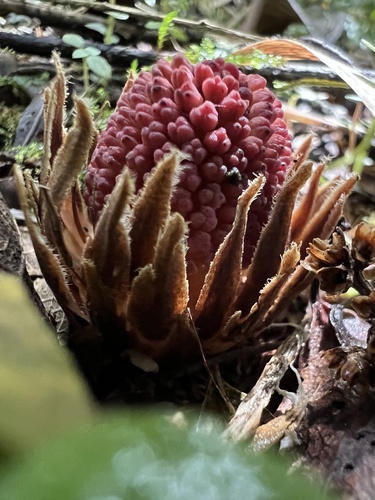
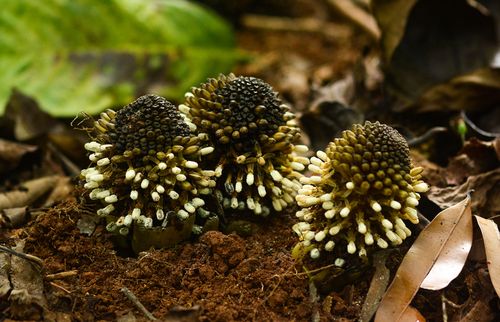
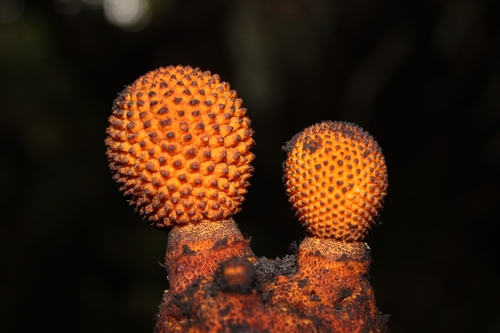
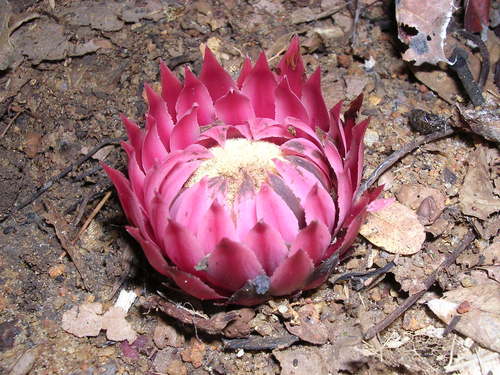
Thonningia sanguinea Vahl is a fleshy dioecious herb that grows from an underground tuber, which it uses to parasitize other plants. This branching, yellowish tuber extends horizontally through soil up to 10 or 15 centimeters, and forms bulb-like gall swellings at attachment points on host plant roots; these galls can grow over 18 centimeters wide. While the tuber may resemble a rhizome, this species does not produce a true rhizome. Its stem is covered in spirals of scale-like leaves. The leaves contain no chlorophyll and are not green, since the plant gets all its nutrients from its hosts and does not perform photosynthesis. A flowering stem emerges above ground to bear a bright red or pink inflorescence that holds both male and female flowers. The crowded flower heads are covered in scales, and the full inflorescence can reach 15 to 20 centimeters in length. This species grows in forests and other habitats, and is frequently found in plantations, where it parasitizes crop trees including rubber (Hevea brasiliensis), date (Phoenix dactylifera), and cocoa (Theobroma cacao). Thonningia sanguinea is pollinated by flies and ants. Flies from the Muscidae and Calliphoridae families, plus ants from the genus Technomyrmex, visit the flowers to feed on nectar, and pollinate the flowers as they enter. Muscid flies from the genus Morellia lay their eggs in the flowers, and the hatching larvae feed on the male flowers. This interaction may be an example of mutualism: the fly pollinates the plant, and the plant provides a site for egg-laying and nutrition for the fly larvae. Many African cultures use this plant as a traditional remedy. In Ghana, it is used for sexually transmitted diseases; in the Congo, it is used for diarrhea. A portion of the leaves is used to treat worm infections. When mixed with Capsicum, it is applied topically to treat hemorrhoids and torticollis. It is also used to treat leprosy, skin infections and abscesses, dental caries, gingivitis, and heart disease. In Zaire, the plant is said to prevent incontinence and bedwetting. Additional uses include being an ingredient in poison for hunting arrows made by peoples of Côte d'Ivoire, and acting as a flavoring for soup. In some regions, the flower heads are regarded as an aphrodisiac. In Ghana and Côte d'Ivoire, the spiky flower heads are tied to toddlers' ankles to encourage them to learn to walk, as the spikes prevent the children from sitting down. All parts of the plant are used. Thonningia sanguinea is considered a weed in some areas, such as rubber plantations, where it can grow in large abundant populations.