About Thomasia petalocalyx F.Muell.
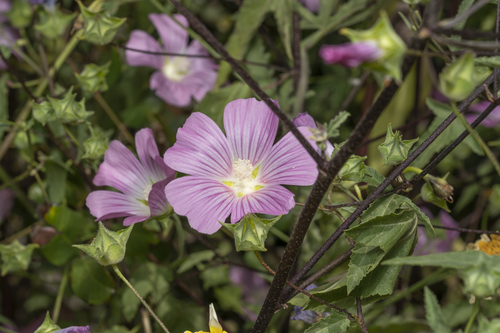
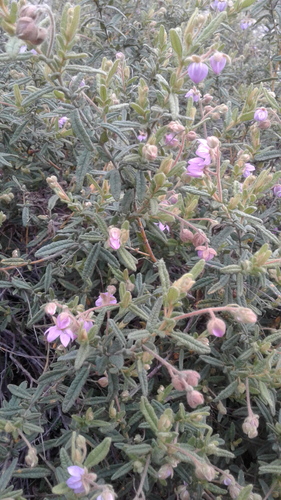
Thomasia petalocalyx, commonly called paper flower, is a flowering shrub that typically reaches 0.5 to 1.5 metres (1 foot 8 inches to 4 feet 11 inches) in height and 0.5 to 2 metres (1 foot 8 inches to 6 feet 7 inches) in width. All new growth on this species is covered in star-shaped hairs. The leaves are oblong to egg-shaped, measuring 20 to 40 millimetres (0.79 to 1.57 inches) long and 5 to 13 millimetres (0.20 to 0.51 inches) wide, and grow on a 2 to 8 millimetre (0.079 to 0.315 inch) long petiole. Hairy brown, wing-like stipules that are 8 to 12 millimetres (0.31 to 0.47 inches) long are present at the base of each petiole. The leaves themselves are covered with star-shaped hairs, and their edges are wrinkled, turned downwards, and finely toothed. Flowers are arranged either singly or in racemes of up to 5 flowers, held on a 30 to 40 millimetre (1.2 to 1.6 inch) long red peduncle near the ends of branches. Each individual flower sits on a 6 to 8 millimetre (0.24 to 0.31 inch) long pedicel, with three 5 to 6 millimetre (0.20 to 0.24 inch) long bracteoles at the base of the pedicel. The sepals are mauve and form a cup-shaped flower 10 to 15 millimetres (0.39 to 0.59 inches) wide, while the petals are deep red and very small. This species grows in forest, woodland, coastal heath, and on granite outcrops. Its distribution includes the Esperance Plains, Jarrah Forest and Mallee bioregions of southern Western Australia; south-eastern South Australia, including Kangaroo Island; and scattered locations in western and south-western Victoria, with an isolated, common population on Wilsons Promontory.