About Thlypopsis sordida (d'Orbigny & Lafresnaye, 1837)
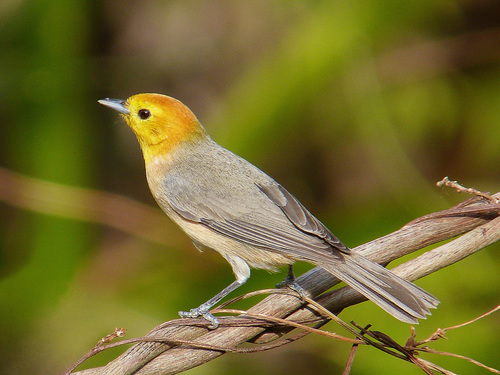
The orange-headed tanager, with scientific name Thlypopsis sordida (d'Orbigny & Lafresnaye, 1837), is a small thin-billed tanager. It has an average length of 13 cm (5.1 in) and a weight between 14 and 19 g (0.49–0.67 oz). Its body proportions match those of a New World warbler. Males of the nominate subspecies have rufous-orange coloring on the crown and sides of the head, which transitions to bright yellow on the lores, the area surrounding the eye, and the throat. The upperparts are sandy-gray, with dusky primary coverts and flight feathers; the flight feathers are edged with gray. The underparts range from buff to cinnamon, becoming whitish on the center of the lower breast, belly, and undertail coverts. The bill is dark, the iris is dark brown, and the legs are gray. Females have duller upperparts than males, have less extensive yellow on the head, and their face and throat yellow is also duller. Immature birds look similar to females but are even duller, with grayish-olive upperparts and paler underparts.
This species is native to South America, occurring in Argentina, Bolivia, Brazil, Colombia, Ecuador, Paraguay, Peru, and Venezuela. It is the only member of its genus found in Amazon rainforest lowlands. In Venezuela and the western Amazon, it lives in successional vegetation such as tall Gynerium grasses, willows, Tessaria and Cecropia shrubbery, and young secondary growth near rivers and on river islands. In the southern Amazon, it inhabits dry to semi-humid cerrado, open woodland canopies, shrubland, parks, and thin riparian forest (forest growing alongside waterbodies). In northwestern Argentina, it lives in scrub, brush, and the edges of drier open woodland, and is rarely seen in uninterrupted forest. It generally lives at elevations up to 800 m (2,600 ft); in Venezuela it only occurs up to 100 m (330 ft), and in Colombia up to 400 m (1,300 ft). Local populations in Bolivia can live as high as 1,500 m (4,900 ft). In Brazil and Argentina, populations of this species seasonally migrate from the Andes to lowlands during the austral winter.
In behavior and ecology, the orange-headed tanager occurs in pairs or groups of 3 to 4 individuals, and is occasionally found in mixed-species foraging flocks.