About Thinornis novaeseelandiae (J.F.Gmelin, 1789)
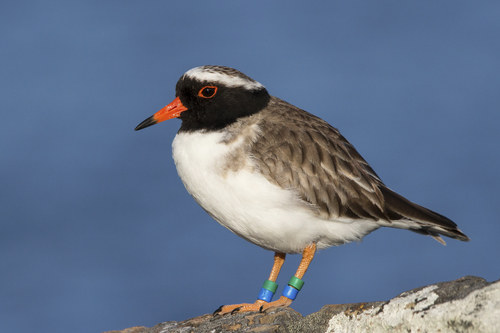
Shore plover, the common name for Thinornis novaeseelandiae (J.F.Gmelin, 1789), reaches roughly 20 cm in total length. It has brown plumage on its upper body and white plumage on its underbody. Males have a black facial mask, while females have a brown facial mask. The brown feathers of its back have narrow pale fringes, which create a scaly texture when viewed at close range. A distinct white stripe circles the head just below the brown cap on top of the skull. This species has bright orange-red legs, and an orange-red bill that is brighter in males than in females, with a clearly defined dark tip. Its brown wings feature a narrow white wingbar that runs their entire length, and its brown tail has white edges along the sides. Juvenile shore plovers differ from adults: they do not have a complete dark face mask, and their brown back feathers have broader pale fringes, which gives the upper body an even more prominent scaly appearance. Historically, this species was only recorded along the coast of New Zealand. However, subfossil shore plover bones have been found in the roosts of the extinct laughing owl, located near rivers many kilometers inland. During James Cook's second expedition, specimens were collected from two opposite ends of New Zealand's South Island: Fiordland and the Marlborough Sounds. There are 19th century records of shore plovers from across the South Island and multiple locations on the North Island, but by the 1870s, the species had disappeared from the New Zealand mainland. It survived only on the Chatham Islands after this disappearance. The main cause of this mainland extinction was the introduction of non-native predators, specifically feral cats and brown rats.