About Thinocorus orbignyianus I.Geoffroy Saint-Hilaire & R.Lesson, 1831
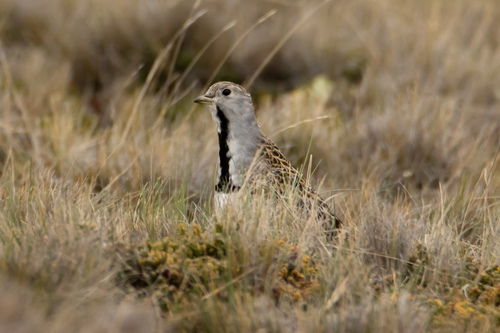
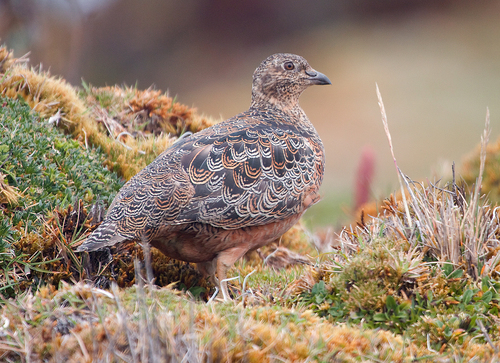
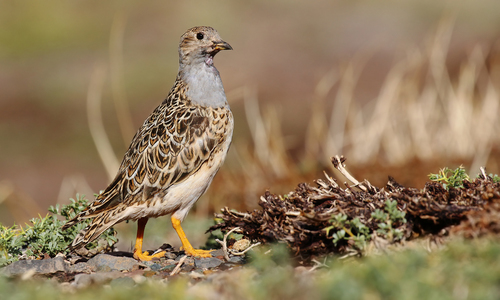
The grey-breasted seedsnipe (scientific name Thinocorus orbignyianus I.Geoffroy Saint-Hilaire & R.Lesson, 1831) has a body length of 19 to 24 cm (7.5 to 9.4 in) and weighs 96 to 140 g (3.4 to 4.9 oz). Males have gray heads, necks, and upper breasts, with a white throat edged in black. Their upperparts are cinnamon buff with a vermiculate pattern, and their wings display visible white bars on both the upper and lower surfaces when in flight. Their lower breast and belly are white, separated from the upper breast by a narrow black band. Females have pale buff heads and breasts marked with heavy dark streaks. The species has two recognized subspecies that are otherwise very similar in appearance, though T. o. ingae has shorter wings and legs than the nominate subspecies. This species is native to the Andes. Subspecies T. o. ingae ranges from Peru's Department of Cajamarca through western Bolivia to northern Chile and northwestern Argentina, reaching as far south as Catamarca Province and possibly Mendoza Province. The nominate subspecies ranges from the Antofagasta Region of northern Chile and La Rioja Province of northwestern Argentina south all the way to Tierra del Fuego. The grey-breasted seedsnipe is a year-round resident across most of its range, though populations that breed in Tierra del Fuego move north for the winter. It also makes seasonal altitudinal movements. It lives in Puna grassland, favoring areas with low matted vegetation or short grass near bogs. In Peru, it is commonly found between 3,400 and 5,000 m (11,200 and 16,400 ft) in elevation. Further south, it mostly breeds above 1,000 m (3,300 ft), but can be found as low as 400 m (1,300 ft) in Chilean Patagonia during the summer.