About Thersamonia thersamon (Esper, 1784)
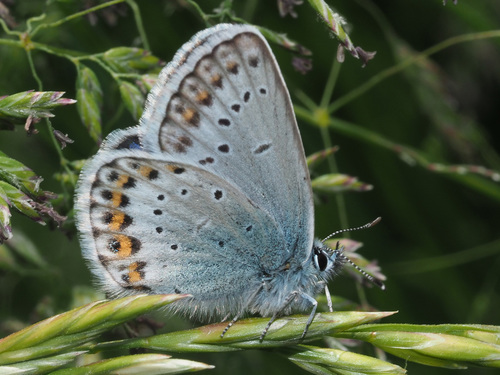
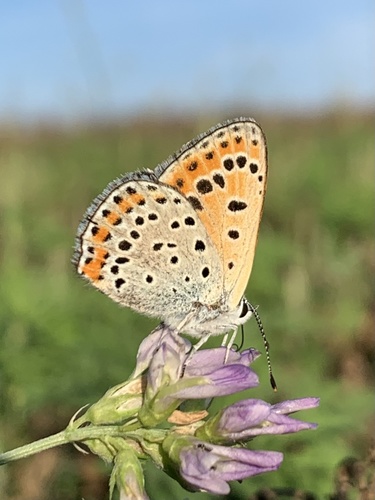
Bright golden-red Thersamonia thersamon butterflies have hindwings that, even in males, are so heavily dusted with dark scaling that a light submarginal band stands out clearly against the background. On the underside, the forewing disc and the hindwing submarginal band are both cinnabar-red, contrasting against the grey ground. This species is distributed across south-east Europe, the eastern districts of Italy opposite the Balkan Peninsula, Asia Minor and Turkestan, extending northwest to Hungary, Bohemia and Saxony. omphale Klug, illustrated at 76e, is the short-tailed summer-form that flies from July until September. In persica Bien., the upperside is very fiery, and the dots of the median row on the hindwing beneath are larger; this form occurs in the sub-alpine region of the mountains northwest of El Meshed, Persia. alaica Gr.-Grsh. has an upperside washed with dark color, a more yellowish underside with larger dots, and is found in Ferghana. The larva is green with swollen segments. It has a yellow, thinly divided dorsal line and a similarly yellow side-line, with darker oblique smears between the two lines. The larva's head and legs are brown. Mature larvae occur in June and again in the autumn on Sarothamnus and Rumex. The pupa is evenly rounded and dark brown. Tailless form butterflies occur in April and May, and omphale form butterflies occur again from July onward. They fly on dry sunny hillsides and are not rare at their flight locations. This species was previously referred to as C. thersamon Esp. (= xanthe Hhn.)