About Theropithecus gelada (Rüppell, 1835)
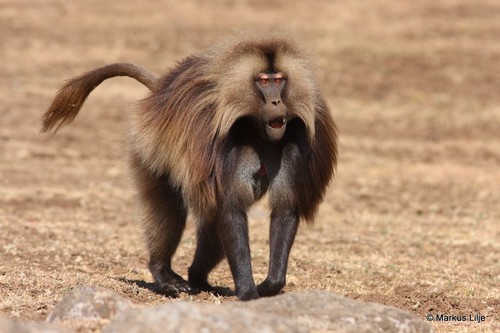
The gelada (Theropithecus gelada, first described by Rüppell in 1835) is a large, robust primate. Its body is covered in coarse hair ranging from buff to dark brown, with a dark face and pale eyelids. Its arms and feet are nearly black, its short tail ends in a tuft of hair, and adult males grow a long, heavy cape of hair on their backs. The gelada has a hairless face with a short muzzle that more closely resembles a chimpanzee's muzzle than a baboon's. It can also be physically distinguished from baboons by a bright, hourglass-shaped patch of bare skin on its chest. In males this patch is bright red and surrounded by white hair; in females the patch is far less pronounced. When females enter estrus, their chest patch brightens, and a necklace of fluid-filled blisters forms on the patch. This feature is thought to be analogous to the swollen buttocks most baboons develop during estrus. Females also have small knobs of skin around their chest patches, and all geladas have well-developed ischial callosities. This species exhibits strong sexual dimorphism: adult males average 18.5 kg (40.8 lb), while smaller adult females average 11 kg (24.3 lb). Head and body length for both sexes ranges from 50–75 cm (19.7–29.5 in), and tail length ranges from 30–50 cm (11.8–19.7 in). The gelada has multiple specific adaptations for its terrestrial, grass-eating (graminivorous) lifestyle. It has small, sturdy fingers adapted for pulling grass, and narrow, small incisors adapted for chewing grass. When feeding, the gelada uses a unique shuffle gait: it squats bipedally and moves by sliding its feet without changing its posture. This gait hides the gelada's rump beneath its body, making the rump unavailable for sexual display, while its bright chest patch remains visible. Geladas are found only in the high grasslands of the deep gorges of the central Ethiopian plateau. They live at elevations between 1,800–4,400 m (5,900–14,400 ft) above sea level, using cliff ledges for sleeping and montane grasslands for foraging. Their habitat includes widely spaced trees, bushes, and dense thickets. The highland areas they inhabit are cooler and less arid than lowland areas, so geladas usually do not face reduced food availability during the dry season. However, geladas in some areas experience frost in the dry season and hailstorms in the wet season. Geladas are the only primates that are primarily graminivores and grazers; grass blades make up to 90% of their diet. They eat both grass blades and grass seeds, and prefer seeds when both are available. When available, they also eat flowers, rhizomes, and roots, digging for rhizomes and roots with their hands. Their diet can also include herbs, small plants, fruits, creepers, bushes, and thistles. Insects are eaten only rarely, and only when easily obtained. During the dry season, geladas prefer herbs over grasses. They chew their food more like ungulates than other primates, and can chew as effectively as zebras. Geladas are primarily diurnal. They sleep on cliff ledges at night, leave the cliffs at sunrise to travel to plateau tops to feed and socialize. After the morning, social activity decreases and geladas focus primarily on foraging while continuing to travel. In the evening before descending to cliffs to sleep, they engage in more social activity. Confirmed predators of geladas include domestic dogs, leopards, servals, hyenas, and lammergeiers. When a female gelada is in estrus, she points her posterior toward a male, raises it, and moves her tail to one side. The male then approaches and inspects her chest and genital areas. Females may copulate up to five times per day, most often around midday. Breeding and birth can occur at any time of year, though some populations have seasonal birth peaks. Most births happen at night. Newborn geladas have red faces, closed eyes, and are covered in black hair, and average 464 g (16.4 oz) at birth. If a new male takes over a harem, females already impregnated by the previous harem leader have an 80% chance of aborting their pregnancies, a pattern known as the Bruce effect. Females enter estrus quickly after giving birth, so males have little incentive to commit infanticide. Infanticide does occur in some communities in Ethiopia's Arsi region, which may incentivize females to abort rather than invest energy in caring for an infant that is likely to be killed. Overall, infanticide is fairly uncommon in geladas compared to other primates that live in one-male social units, such as gorillas or gray langurs. Aborting after a harem takeover is thought to allow females to bond with the new dominant male faster. When a male loses his position as dominant harem master, the existing females and new dominant leader often allow him to remain in the social unit as a nonbreeding resident that acts as a babysitter. This arrangement lets the ex-leader protect any infants he fathered from being killed by the new leader, lets females protect the ex-leader's infants, and means the ex-leader will be more likely to help the new dominant male fend off rival challengers. Infant mortality is highest during the wet season, but on average over 85% of gelada infants survive to their fourth birthday. This high survival rate is attributed to their habitat having a food source few other animals can exploit, so it cannot support large numbers of large predators. Females that have just given birth stay on the periphery of their reproductive social unit. Other adult females may show interest in newborns and even kidnap them. Infants are carried on their mother's belly for the first five weeks, then carried on her back after that. Infants become able to move independently around five months old. When infants reach six months old, subordinate males in the reproductive unit may help care for them. When larger herds form, juveniles and infants often gather into play groups of around 10 individuals. When males reach puberty, they leave reproductive units to join unstable all-male groups. Females reach sexual maturity around three years old, but do not give birth for an additional year. Males reach puberty around four to five years old, but social constraints usually prevent them from reproducing until they are eight to ten years old. The average lifespan of geladas in the wild is 15 years.